
Table of Contents
Enterprise Test Automation Services | Scalable Test Engineering | Sandhata
Enterprise organizations operate under constant market pressure to launch innovative digital services, update customer platforms, and comply with rapidly shifting regulatory requirements. However, as enterprise software systems expand across microservices, hybrid cloud infrastructure, middleware buses, and core legacy mainframes, verifying that software changes do not break critical business processes becomes increasingly difficult.
Historically, organizations relied on large QA teams performing manual regression testing prior to major software releases. Manual testing is slow, expensive, prone to human error, and incapable of providing the comprehensive test coverage required for modern continuous delivery pipelines. When manual testing cycles require weeks to execute, software release cadences stall, feature backlogs grow, and deployment risks increase.
Even organizations that adopted early test automation frameworks frequently encounter obstacles. Over time, legacy test scripts become brittle, slow, and unreliable, resulting in high rates of false-positive test failures (test flakiness). Engineering teams spend valuable time repairing broken scripts rather than delivering business features.
Enterprise Test Automation Services resolve these systemic challenges. By architecting scalable automated testing frameworks, migrating legacy test suites to modern platforms like Playwright, virtualizing downstream system dependencies, and embedding shift-left continuous testing into CI/CD pipelines, enterprises convert software quality from a release bottleneck into a high-speed business accelerator.
This comprehensive guide presents the technical strategies, framework architectures, and governance models that Sandhata Technologies delivers to help regulated global enterprises build resilient, scalable test automation ecosystems.
Section 1: The Enterprise Software Testing Challenge
Achieving high-velocity software delivery while maintaining system reliability requires overcoming complex architectural and operational obstacles inherent in large-scale IT environments.
1.1 The Failure of Manual QA at Enterprise Scale
Traditional manual quality assurance processes were built for monolithic application releases scheduled months apart. In modern enterprise environments characterized by rapid code commits and microservice updates, manual testing cannot keep pace.
Manual regression testing across complex multi-tier applications requires extensive manual effort and takes weeks to complete. Because manual testing occurs late in the delivery cycle, finding and fixing architectural defects requires expensive code rework. Furthermore, manual validation cannot achieve the execution depth or throughput needed to test complex data scenarios and high-volume transaction flows.
1.2 Brittle Legacy Test Automation and High Maintenance Costs
To move away from manual testing, many enterprise organizations built automated test suites using early-generation testing tools. Over time, these legacy test suites suffer from severe maintenance drag.
Brittle test scripts fail frequently due to minor UI modifications, timing issues, or dynamic web elements. This flakiness undermines team confidence in automated test results, as engineers must manually verify whether every test failure represents a real software bug or a script timing error. Consequently, test suite execution slows down, maintenance costs escalate, and teams revert to manual testing.
1.3 System Dependency Bottlenecks and Environment Scheduling Conflicts
Enterprise applications rarely operate in isolation. A single user interaction on a mobile app may trigger cascading calls across cloud microservices, payment gateways, credit check APIs, and core mainframe databases.
Executing comprehensive end-to-end automated tests requires access to fully populated, stable staging environments. However, fixed staging environments are frequently unavailable, undergoing maintenance, or configured with stale test data. Waiting for physical downstream dependencies introduces long testing delays and blocks release pipelines.
1.4 Regulatory Governance and Compliance Pressures
Enterprise organizations operating in regulated sectors—such as banking, financial services, insurance, telecommunications, and healthcare—must satisfy stringent regulatory mandates.
Regulations such as DORA, PRA rules, PCI-DSS, and GDPR require documented proof of rigorous software testing, access control segregation, data privacy protections, and audit trail records. Executing manual compliance checks and managing unmasked test data in non-production environments creates severe compliance exposure and slows deployment velocity.
Section 2: Core Engineering Pillars of Sandhata’s Enterprise Test Automation Services
Sandhata Technologies provides specialized Enterprise Test Automation Services engineered specifically to overcome these complex challenges. Sandhata combines modern test architecture design, framework migration, Service Virtualization, synthetic test data management, and hyperautomation into a unified continuous testing strategy.
2.1 Pillar 1: Framework Modernization and Playwright Migration
To eliminate test script brittleness and maximize execution speed, Sandhata specializes in modernizing legacy test automation frameworks. Sandhata leads enterprise migrations from legacy Selenium test suites to modern, high-performance automation platforms such as Playwright and Cypress.
Playwright provides native multi-browser automation capabilities, automatic waiting mechanisms, parallel test execution, and superior handling of modern single-page applications. Sandhata constructs modular, maintainable automation architectures utilizing the Page Object Model (POM) pattern. This approach isolates UI element locators from test logic, ensuring that application UI updates require minimal maintenance changes across test suites.
2.2 Pillar 2: Shift-Left Continuous Test Automation in CI/CD Pipelines
Sandhata integrates automated testing directly into developer workflows, shifting quality validation left to the earliest stages of the software lifecycle.
Rather than running test suites only in staging environments, automated unit tests, component validations, and API contract tests execute automatically during developer code commits and pull request creations. By catching code defects early during local build compilation, developers fix bugs in minutes rather than spending days troubleshooting issues in lower environments.
2.3 Pillar 3: Service Virtualization for Backend and Third-Party Decoupling
Testing enterprise applications often stalls when staging environments wait for unavailable third-party APIs, external payment processing clearinghouses, or core legacy mainframes.
Sandhata eliminates these environment dependencies using Service Virtualization. Service Virtualization simulates the behavior, transactional payload responses, and performance profiles of backend mainframes and external services. Automated test suites execute against these virtualized services continuously in lower environments without waiting for physical system availability or risking live transactional data.
2.4 Pillar 4: Synthetic Test Data Management and Privacy Compliance
Executing reliable automated tests requires high-quality, realistic test data. However, copying production customer databases into non-production testing environments violates strict data privacy regulations like GDPR and HIPAA.
Sandhata resolves this challenge by delivering automated synthetic test data management solutions. Sandhata implements automated data masking and synthetic data generation tools that create realistic test datasets mirroring production database structures without containing real personal identity details. Automated test pipelines spin up fresh, masked test data on demand, ensuring complete data privacy compliance.
2.5 Pillar 5: Mainframe and Multi-Tier Hybrid Test Automation
Many large-scale financial institutions, telecommunications operators, and insurance providers operate core business logic on legacy mainframes integrated with cloud microservices. Enterprise test automation must cover the entire hybrid stack.
Sandhata builds unified test automation engines capable of validating end-to-end transaction flows across hybrid architectures. Automated test scripts interact seamlessly with cloud web interfaces, REST/gRPC APIs, middleware message queues, and backend COBOL mainframe transaction monitors, verifying data integrity across every architectural layer.
2.6 Pillar 6: AI-Driven Automation and ATOM2 Hyperautomation
To streamline test creation and reduce operational overhead, Sandhata leverages hyperautomation technologies, anchored by Sandhata’s proprietary ATOM2 platform.
ATOM2 provides low-code and no-code automation interfaces, allowing business analysts, quality engineers, and developers to collaborate on test scenario design. ATOM2 connects disparate testing utilities, automates complex multi-system validation sequences, and utilizes smart execution algorithms to run only the specific test suites impacted by recent code commits, optimizing resource utilization.
Section 3: Evaluating Test Automation Maturity with the DevOps & SRE Maturity Compass
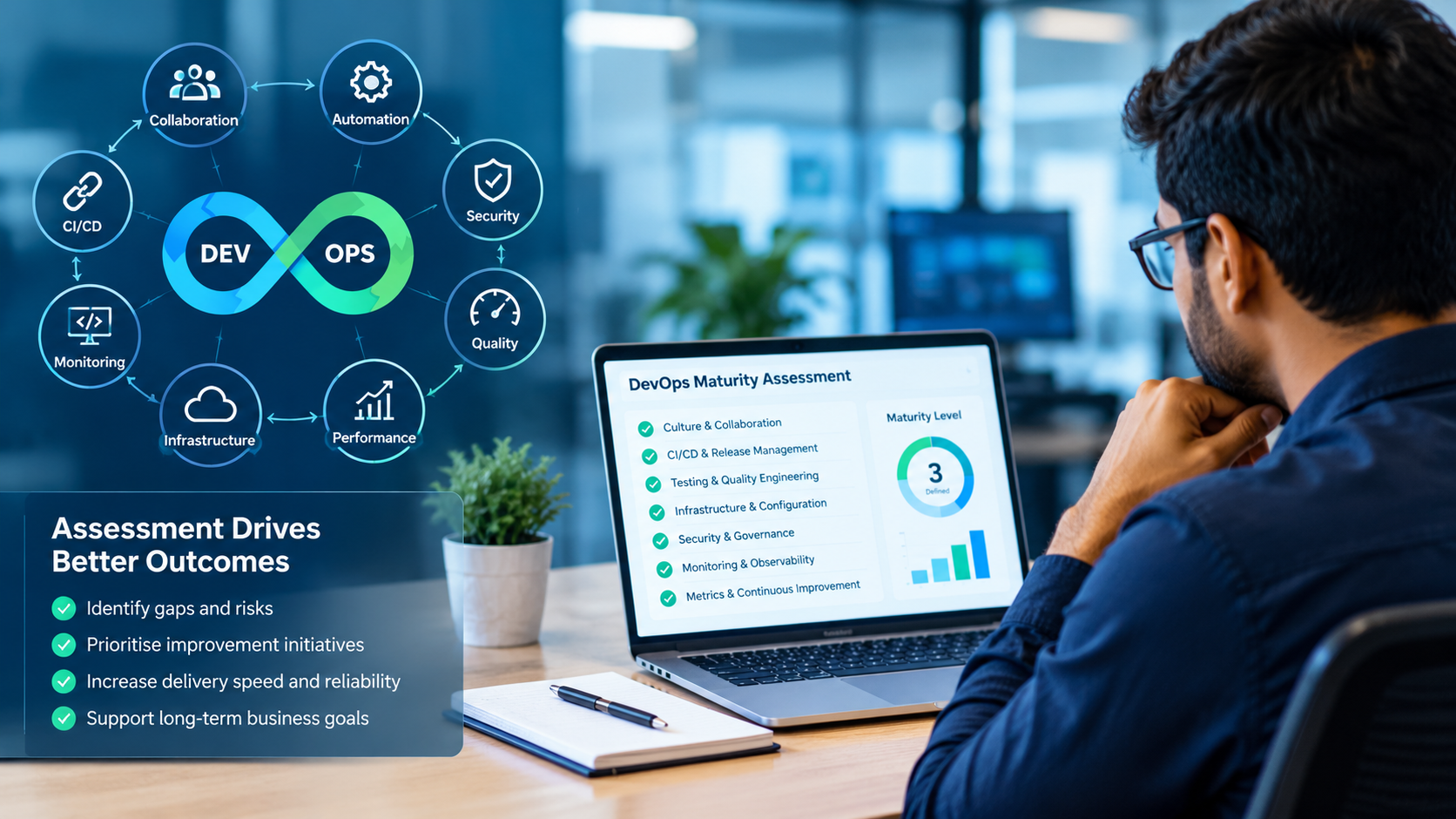
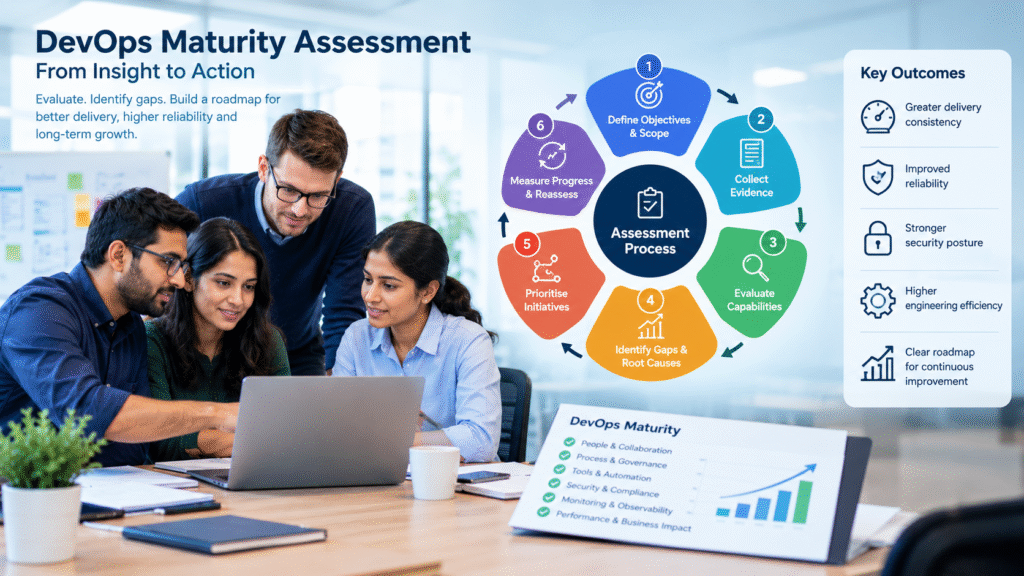
Sandhata applies the DevOps & SRE Maturity Compass to assist executive teams in evaluating their current software testing practices and defining a clear modernization roadmap.
Level 1: Manual Ad-Hoc Testing. Software testing depends almost entirely on manual execution. Test scripts are undocumented, staging environments suffer from configuration drift, and software release lead times take months.
Level 2: Fragmented Legacy Scripting. Teams utilize isolated test automation scripts (such as legacy Selenium) for basic web testing. However, scripts suffer from high flakiness, maintenance costs remain high, and API, performance, and security testing remain manual.
Level 3: Integrated Continuous Test Automation. Automated test suites written in modern frameworks like Playwright execute automatically within CI/CD pipelines. Service Virtualization removes environment dependencies, synthetic test data ensures GDPR compliance, and quality gates control deployment progress.
Level 4: Hyperautomated Continuous Quality. Test suites leverage AI-driven hyperautomation via Sandhata’s ATOM2 platform. Ephemeral environments validate feature branches dynamically, self-healing test scripts handle minor application modifications automatically, and real-time observability channels feed performance metrics back into development workflows.
The Maturity Compass offers enterprise leadership clear visibility into testing bottlenecks, operational risks, and strategic steps to achieve modern test automation maturity.
Section 4: Enterprise Impact – Real-World Test Automation Case Studies
Case Study 1: Global Tier-1 Investment Bank Test Framework Modernization
A global investment bank operated complex trading and wealth management platforms. Legacy manual regression testing cycles for core trading updates required 20 days across large QA teams, delaying feature rollouts and causing high operational maintenance spend.
Sandhata deployed a dedicated team of test automation engineers to transform the bank’s quality strategy. Sandhata migrated brittle legacy test scripts to a high-speed Playwright automation framework, introduced Service Virtualization for core trading feeds, and embedded automated synthetic test data masking within CI/CD pipelines.
Regression test execution time dropped by 90%, falling from 20 days to under 16 hours. Defect escape rates to production dropped by 84%, while deployment frequency increased from quarterly release batches to bi-weekly continuous releases with zero downtime.
Case Study 2: Major Telecom Provider Automated API and Billing Integration Testing
A multinational telecommunications provider struggled with long testing delays when deploying updates to its customer account management and billing engines. Development teams spent weeks waiting for access to shared staging environments and external partner APIs.
Sandhata engineered an enterprise Service Virtualization and test automation solution. Sandhata virtualized over 35 external partner endpoints and automated API integration testing within unified continuous integration pipelines.
Environment wait time was reduced to zero, saving over 15,000 engineering hours annually. Test execution cycles accelerated by 80%, enabling the telecom provider to launch modern 5G subscriber packages months ahead of market competitors.
Section 5: Essential Metrics for Enterprise Test Automation Success
Evaluating the return on investment of an enterprise test automation transformation requires measuring key performance indicators across execution speed, quality, and operational efficiency:
Automated Test Coverage: The percentage of business requirements, API endpoints, and user journeys validated by automated test suites, targeting over 85% coverage across core systems.
Regression Execution Duration: The total elapsed time required to execute a complete enterprise regression test suite, reduced from weeks to hours via modern automation.
Test Flakiness Rate: The percentage of test failures caused by script instability or network timing issues rather than genuine software defects, targeted below 1%.
Defect Escape Rate: The percentage of software defects identified in production relative to total defects caught during development and testing.
Lead Time for Quality: The time elapsed from code commit to complete automated quality validation, including functional, performance, and security testing.
Environment Wait Time: The duration development teams spend waiting for test environment availability, reduced to zero using Service Virtualization and ephemeral environments.
Section 6: Frequently Asked Questions (FAQs)
FAQ 1: What are Enterprise Test Automation Services?
Enterprise Test Automation Services are specialized engineering solutions that design, build, and optimize automated software testing frameworks across large-scale organizational architectures. These services integrate continuous testing into CI/CD pipelines, modernize legacy test suites, virtualize environment dependencies, and enforce automated quality gates.
FAQ 2: How does enterprise test automation differ from basic test scripting?
Basic test scripting focuses on automating individual UI test actions in isolation. Enterprise test automation delivers scalable, maintainable architectures that handle multi-tier application workflows, parallel execution, cross-browser compatibility, dynamic test data masking, Service Virtualization, and automated pipeline integration across complex cloud and mainframe environments.
FAQ 3: Why are enterprise organizations migrating from Selenium to Playwright?
Enterprises are migrating to Playwright due to its significantly faster execution speeds, native support for modern single-page applications, built-in auto-waiting mechanisms, parallel test runner capabilities, and reduced test maintenance overhead compared to legacy Selenium setups.
FAQ 4: What is Service Virtualization and why is it critical for enterprise test automation?
Service Virtualization simulates the behavior and data responses of unavailable or complex downstream systems, such as legacy mainframes, payment processing gateways, or third-party APIs. It allows automated test suites to execute continuously in lower environments without waiting for physical system availability.
FAQ 5: How does test automation support continuous delivery in regulated industries?
In regulated sectors like banking and healthcare, test automation executes comprehensive security, performance, and compliance checks automatically during pipeline builds, generating immutable audit logs that satisfy regulatory mandates like DORA, PRA rules, PCI-DSS, and HIPAA.
FAQ 6: What is Sandhata’s ATOM2 platform and how does it enhance test automation?
ATOM2 is Sandhata’s proprietary hyperautomation framework that provides low-code and no-code automation capabilities, connecting disparate testing utilities, simplifying test suite orchestration, and accelerating automation adoption across technical and non-technical enterprise teams.
FAQ 7: Can test automation be executed across legacy mainframe architectures?
Yes. Sandhata builds specialized hybrid testing connectors that allow automated testing suites to interact with legacy mainframe transaction monitors, batch jobs, and COBOL backends simultaneously with modern web APIs and cloud microservices.
FAQ 8: How does Sandhata solve the issue of test flakiness in automated test suites?
Sandhata resolves test flakiness by refactoring test scripts into page-object design patterns, implementing dynamic auto-waiting strategies, virtualizing unstable network dependencies, and ensuring dynamic isolation of test data environments.
FAQ 9: What is Shift-Left Testing in enterprise test automation?
Shift-Left Testing moves quality validation to early stages of the software development lifecycle. Automated unit, contract, and component tests run continuously during developer code commits, catching defects when they are easiest and cheapest to fix.
FAQ 10: How does Sandhata handle GDPR compliance and test data management?
Sandhata implements automated test data management solutions that generate synthetic data or automatically mask sensitive personal information in real time, ensuring non-production environments remain fully compliant with GDPR and privacy laws.
FAQ 11: What metrics measure the efficiency of enterprise test automation?
Key metrics include Automated Test Coverage, Regression Execution Time, Test Flakiness Rate, Defect Escape Rate, Lead Time for Quality, and Cost per Test Execution.
FAQ 12: How does Sandhata evaluate an enterprise’s testing maturity?
Sandhata uses the DevOps & SRE Maturity Compass to audit enterprise testing practices across 30 to 40 measurement dimensions, identifying automation gaps, execution bottlenecks, and architectural dependencies.
FAQ 13: What is Non-Functional Test Automation?
Non-Functional Test Automation automates the verification of system attributes other than functional business logic, including load scalability, performance latency, security vulnerability scanning, and accessibility compliance.
FAQ 14: How do ephemeral environments benefit enterprise test automation?
Ephemeral environments are temporary cloud setups provisioned automatically on demand for specific feature branch testing. Automated test suites execute against these clean environments, which are destroyed immediately afterward, reducing cloud costs and environment conflicts.
FAQ 15: How long does a typical Enterprise Test Automation transformation take with Sandhata?
Initial diagnostic audits using the Maturity Compass take 2 to 4 weeks. Automated framework implementation, high-priority test suite migration, and CI/CD pipeline integration yield initial operational results within 8 to 12 weeks.
Strategic Recommendation and Next Steps
Relying on manual testing cycles, brittle legacy test scripts, and fixed staging environments creates severe release bottlenecks, high operational costs, and elevated risk of production outages. To compete effectively in digital markets, enterprise leaders must modernise their testing strategy into an automated, continuous, and scalable engineering discipline.
Enterprise Test Automation Services provide a practical path toward continuous software delivery. By modernizing test frameworks with Playwright, shifting testing left, virtualizing downstream dependencies, implementing synthetic test data management, and leveraging hyperautomation via ATOM2, enterprise organizations can release software rapidly with total confidence.
Sandhata Technologies brings over two decades of engineering excellence in enterprise quality automation, DevOps integration, and legacy modernization across heavily regulated industries.
Contact Sandhata’s Enterprise Test Automation Specialists today to schedule your DevOps & SRE Maturity Compass Assessment and build your next-generation test automation platform.




Leave a Comment
You must be logged in to post a comment.