
Table of Contents
Software Testing Strategy for Enterprises | Quality Engineering | Sandhata
Digital transformation has fundamentally changed how large organizations build and deliver software. Enterprises across banking, telecommunications, insurance, healthcare, and retail no longer release software updates once or twice a year. Today, competitive success demands continuous innovation, weekly or daily feature releases, and seamless digital customer experiences.
However, enterprise technology stacks are deeply complex. Customer-facing mobile apps and web portals rely on hundreds of cloud microservices, middleware routing engines, external partner payment APIs, and core legacy mainframes. Without a clear, unified testing plan, accelerating software releases introduces severe risks of system outages, security breaches, and regulatory fines.
Many enterprise organizations struggle because their testing efforts are fragmented. Individual development teams pick different testing tools, rely on slow manual regression testing, fight over shared testing environments, and discover critical defects right before launch. This reactive approach inflates operational budgets, delays product launches, and frustrates engineering teams.
A cohesive Software Testing Strategy for Enterprises resolves these systemic problems. Rather than treating testing as a final gate before production, a modern strategy transforms quality into a continuous, automated engineering discipline embedded throughout the entire software delivery lifecycle.
This comprehensive guide presents the core architectural pillars, risk-based methodologies, governance models, and transformation roadmaps that Sandhata Technologies delivers to help global enterprises achieve fast, reliable, and compliant software delivery.
Section 1: Why Fragmented Testing Fails in Modern Enterprises
Understanding the structural flaws of ad-hoc quality assurance is the first step toward building a resilient enterprise testing strategy.
1.1 Tool Sprawl and Disconnected Team Silos
In large organizations, independent business units often select testing tools and write scripts without central architectural guidance. One team builds tests in legacy Selenium, another uses commercial licensing tools, and a third relies entirely on manual spreadsheets.
This tool sprawl creates high licensing costs, prevents code reuse across teams, and makes it impossible for technology leaders to gain clear visibility into overall enterprise software quality. When end-to-end customer journeys cross multiple business systems, disconnected testing silos leave dangerous blind spots.
1.2 The Inverted Testing Pyramid Trap
Many enterprises accidentally invert the classic Test Automation Pyramid. Instead of building a strong foundation of fast unit and API tests, teams focus almost entirely on automating slow, brittle end-to-end user interface tests.
Because user interface tests take a long time to run and break frequently whenever page layouts change, regression suites become slow and unreliable. Teams spend massive budgets maintaining fragile interface scripts while underlying backend logic and API integrations remain under-tested.
1.3 Environment Bottlenecks and Test Data Friction
Enterprise testing frequently grinds to a halt while teams wait for access to shared staging environments or unavailable third-party services. When multiple teams test simultaneously in the same shared environment, test data gets overwritten, causing false failures and wasted debugging hours.
Furthermore, copying unmasked production customer databases into testing environments creates severe compliance exposure under data privacy laws such as GDPR and HIPAA.
1.4 Late-Stage Security and Performance Surprises
When performance load testing, security vulnerability scanning, and accessibility checks are left until the final week before launch, discovering an architectural bottleneck or security flaw causes immediate release delays. Fixing structural issues late in the project costs up to one hundred times more than catching them during early development.
Section 2: Core Pillars of a Modern Enterprise Testing Strategy
Sandhata Technologies partners with enterprise technology leaders to design and implement holistic testing strategies built on six foundational engineering pillars.
2.1 Pillar 1: Shift-Left Quality Engineering and the Balanced Pyramid
A modern testing strategy shifts quality validation left into the earliest phases of development. Sandhata guides enterprises in establishing a balanced Test Automation Pyramid.
At the base, developers write fast, isolated unit tests that run in seconds during local code compilation. In the middle layer, quality engineers automate comprehensive API contract tests, microservice integration checks, and component validations. At the top layer, targeted end-to-end user interface tests validate critical customer journeys across browsers and mobile devices.
By catching defects at the unit and API layers, teams receive instant feedback and resolve bugs in minutes rather than weeks.
2.2 Pillar 2: Risk-Based Testing Prioritization
Testing every single line of code with equal intensity is neither practical nor cost-effective at enterprise scale. Sandhata embeds Risk-Based Testing directly into the enterprise strategy.
Sandhata works with business stakeholders and engineering leads to classify software features based on business impact, regulatory exposure, and technical complexity. Mission-critical payment processing engines, core banking ledgers, and high-traffic authentication workflows receive exhaustive automated regression, performance, and security testing. Low-risk, static informational pages receive lighter validation. This risk-driven focus maximizes return on testing investment and accelerates release timelines.
2.3 Pillar 3: Framework Standardization and Modern Tooling (Playwright)
To eliminate tool sprawl and script flakiness, an enterprise testing strategy must standardize on modern, maintainable automation frameworks.
Sandhata helps enterprises consolidate fragmented tools and migrate legacy Selenium suites to modern frameworks like Playwright. Playwright offers ultra-fast execution speeds, built-in automatic element waiting, native parallel worker execution, and cross-browser support across Chromium, Firefox, and WebKit. Sandhata designs reusable Page Object Model architectures so teams across the enterprise share common libraries and coding standards.
2.4 Pillar 4: Service Virtualization and Ephemeral Environments
To eliminate environment scheduling conflicts, a robust enterprise strategy decouples testing from physical downstream dependencies.
Sandhata implements Service Virtualization to simulate unavailable third-party APIs, payment clearing networks, and core legacy mainframes. Automated test suites execute continuously against virtualized endpoints without waiting for external systems. Additionally, Sandhata leverages Infrastructure as Code to spin up temporary, isolated cloud testing environments (ephemeral environments) on demand for feature testing, tearing them down automatically once validation finishes.
2.5 Pillar 5: Synthetic Test Data Management and Privacy Governance
An enterprise testing strategy must treat test data as a first-class engineering asset while enforcing strict data privacy compliance.
Sandhata establishes automated test data management pipelines utilizing synthetic data generation and real-time data masking. Automated engines generate realistic, compliant datasets that mirror production structures without containing real personal customer information. Tests receive fresh, isolated datasets on demand, preventing data collisions and guaranteeing complete compliance with GDPR, HIPAA, and financial privacy mandates.
2.6 Pillar 6: Integrated Non-Functional Testing and Automated Compliance Gates
Functional correctness is not enough if an enterprise application crashes under peak traffic or exposes sensitive customer data. Sandhata integrates Non-Functional Testing directly into continuous delivery pipelines.
Automated performance load tests verify system scalability during every major build. DevSecOps security scanners check source code, open-source libraries, and container images for vulnerabilities automatically. Accessibility checks verify WCAG compliance. Automated quality gates enforce strict pass criteria inside CI/CD pipelines, generating tamper-proof audit logs required for regulatory frameworks like DORA, PRA rules, and PCI-DSS.
Section 3: Evaluating Strategic Readiness with the Maturity Compass
Before writing a single line of automation code, enterprise leaders must understand their current operational baseline. Sandhata applies the proprietary DevOps & SRE Maturity Compass to evaluate enterprise testing capabilities across 30 to 40 technical and organizational dimensions.
Level 1: Ad-Hoc Manual Testing. Quality assurance occurs manually at the end of development cycles. Tool sprawl is widespread, staging environments suffer from configuration drift, and software release lead times span months.
Level 2: Siloed Basic Automation. Individual teams automate basic web scripts using legacy tools, but scripts suffer from high flakiness. API testing, performance validation, and security reviews remain manual, disconnected activities.
Level 3: Standardized Continuous Quality. The enterprise operates unified automation frameworks like Playwright integrated into CI/CD pipelines. Service Virtualization removes environment bottlenecks, synthetic test data ensures GDPR compliance, and automated quality gates enforce release standards.
Level 4: Autonomous Risk-Based Quality Engineering. AI-driven hyperautomation (powered by Sandhata’s ATOM2 platform) optimizes test execution dynamically based on code change impact. Ephemeral environments validate feature branches on demand, self-healing scripts handle minor UI updates automatically, and production observability telemetry continuously informs testing priorities.
The Maturity Compass gives executive leadership clear visibility into operational risks, skill gaps, and a phased roadmap for achieving enterprise quality maturity.
Section 4: Enterprise Impact – Real-World Strategy Transformations
Case Study 1: Global Banking Group Unifies Quality Engineering Across 150 Teams
A multinational banking group operated over 150 software development teams across retail banking, wealth management, and commercial lending. Each division used different testing tools, manual regression testing took up to four weeks per release, and environment conflicts delayed product launches.
Sandhata partnered with the bank’s executive leadership to design and roll out a unified Enterprise Software Testing Strategy. Sandhata conducted a comprehensive Maturity Compass audit, standardized web automation on a modular Playwright framework, deployed enterprise Service Virtualization for core mainframe ledgers, and established automated synthetic test data pipelines.
Within twelve months, regression testing cycles dropped by 85 percent, falling from four weeks to under 36 hours. Tool consolidation saved millions in redundant licensing fees, while defect escape rates to production fell by 78 percent across all banking channels.
Case Study 2: Leading UK Telecommunications Provider Accelerates Digital Releases
A major UK telecommunications provider struggled with recurring production defects and slow release cycles when updating its customer billing and mobile subscription platforms. Performance and security testing occurred manually right before launch, frequently uncovering critical issues that delayed releases by months.
Sandhata engineered a shift-left, risk-based testing strategy. Sandhata integrated automated API contract testing, Playwright regression suites, automated performance benchmarks, and DevSecOps security gates directly into the provider’s continuous delivery pipelines.
Software release lead time dropped by 75 percent, allowing the provider to move from quarterly releases to bi-weekly digital updates. Change failure rates dropped below 1 percent, ensuring uninterrupted service for millions of mobile and broadband subscribers.
Section 5: Essential Metrics for Measuring Testing Strategy Success
A successful Software Testing Strategy for Enterprises relies on clear, objective metrics to track progress and demonstrate return on investment to executive leadership:
Defect Escape Rate: The percentage of software defects discovered in production environments relative to total defects caught during development and testing, targeted below 2 percent.
Lead Time for Quality: The total elapsed time required from code commit to complete automated quality validation, including functional, performance, and security checks.
Automated Test Coverage: The percentage of high-risk business workflows, API endpoints, and code paths validated by automated tests, targeting over 85 percent coverage across core systems.
Regression Execution Duration: The total time required to execute full regression suites, reduced from weeks to hours via parallel automation and risk-based test selection.
Test Flakiness Rate: The percentage of automated test failures caused by script instability or environment glitches rather than real software bugs, kept below 1 percent.
Cost of Quality: Tracking the total operational expenditure on testing tools, environment maintenance, and defect remediation relative to total engineering delivery output.
Section 6: Frequently Asked Questions (FAQs)
FAQ 1: What is a Software Testing Strategy for Enterprises?
A Software Testing Strategy for Enterprises is a comprehensive, organization-wide blueprint that defines how software quality is planned, built, automated, and verified across all business applications. It aligns testing tools, risk management, environment provisioning, data privacy, and CI/CD pipelines with business goals.
FAQ 2: Why do enterprise organizations need a unified testing strategy instead of team-by-team testing?
When individual project teams choose their own testing tools and rules independently, organizations suffer from duplicated tool licenses, inconsistent quality standards, incompatible scripts, and major integration gaps when connecting microservices with core legacy systems.
FAQ 3: How does the Test Automation Pyramid guide an enterprise testing strategy?
The Test Automation Pyramid recommends building a broad base of fast, low-cost unit tests, a middle layer of API and integration tests, and a smaller top layer of end-to-end user interface tests. This balanced distribution maximizes defect detection speed while minimizing maintenance overhead.
FAQ 4: What is Risk-Based Testing in an enterprise quality strategy?
Risk-Based Testing prioritizes testing effort based on the potential business impact and likelihood of failure for each software feature. Critical payment workflows and high-traffic customer portals receive deep, continuous testing, while low-risk static pages require lighter validation.
FAQ 5: How does Shift-Left Testing fit into a modern enterprise testing strategy?
Shift-Left Testing moves quality checks to the earliest stages of development. Developers run automated unit tests, API contract checks, and static security scans while writing code, catching bugs early when they are easiest and cheapest to fix.
FAQ 6: What role does Service Virtualization play in an enterprise testing strategy?
Service Virtualization simulates unavailable third-party APIs, payment networks, and legacy mainframes. Including Service Virtualization in a testing strategy eliminates environment scheduling bottlenecks and allows automated tests to execute anytime.
FAQ 7: How should an enterprise testing strategy address GDPR and test data privacy?
An enterprise testing strategy must forbid using unmasked production customer data in lower testing environments. Instead, it mandates automated data masking and synthetic test data generation to ensure full compliance with GDPR, HIPAA, and privacy rules.
FAQ 8: Why should modern web testing frameworks like Playwright be part of an enterprise strategy?
Standardizing on modern frameworks like Playwright eliminates script flakiness through built-in auto-waiting, accelerates regression execution via parallel workers, and reduces ongoing maintenance costs across multi-browser web applications.
FAQ 9: Can a single enterprise testing strategy cover both cloud microservices and legacy mainframes?
Yes. Sandhata designs hybrid testing strategies that link modern cloud CI/CD pipelines with legacy mainframe transaction monitors and batch jobs, validating end-to-end customer journeys across every architectural layer.
FAQ 10: How does Non-Functional Testing fit into an enterprise quality blueprint?
A complete testing strategy integrates performance testing, load scalability, security vulnerability scanning (DevSecOps), and WCAG accessibility validation directly into automated pipelines rather than leaving them as late pre-release checks.
FAQ 11: How does Sandhata evaluate an organization’s current testing maturity?
Sandhata uses the proprietary DevOps & SRE Maturity Compass to audit quality engineering practices across 30 to 40 technical dimensions, identifying bottlenecks, skill gaps, tool redundancies, and compliance risks before drafting a strategic roadmap.
FAQ 12: How does Sandhata’s ATOM2 platform support an enterprise testing strategy?
Sandhata’s ATOM2 platform delivers low-code and no-code hyperautomation capabilities that standardize test orchestration, connect disparate tools, and empower both technical engineers and business analysts to participate in quality assurance.
FAQ 13: How does an enterprise testing strategy support regulatory compliance in banking and healthcare?
By enforcing automated quality gates and capturing tamper-proof audit logs of every test pass, security scan, and peer approval, a structured strategy ensures continuous readiness for DORA, PRA rules, PCI-DSS, and HIPAA.
FAQ 14: What key metrics should leadership track to measure testing strategy success?
Executive leaders should track Defect Escape Rate, Lead Time for Quality, Automated Test Coverage, Regression Execution Duration, Test Flakiness Rate, and Cost of Quality.
FAQ 15: How long does it take to design and roll out an enterprise testing strategy with Sandhata?
Discovery audits and strategic roadmap design using the Maturity Compass require 2 to 4 weeks. Implementing core frameworks, automation pilots, and pipeline quality gates delivers measurable operational improvements within 8 to 12 weeks.
Strategic Recommendation and Next Steps
Relying on fragmented testing tools, manual regression cycles, shared environment bottlenecks, and late-stage bug detection exposes enterprise organizations to high operational costs, delayed product launches, and severe reputational risks. To compete effectively in modern digital markets, technology leaders must establish a unified, automated, and forward-looking quality engineering blueprint.
A well-crafted Software Testing Strategy for Enterprises transforms quality from a slow release bottleneck into a sustainable competitive advantage. By shifting testing left, prioritizing high-risk business workflows, standardizing on modern frameworks like Playwright, virtualizing external dependencies, generating synthetic compliant test data, and embedding automated quality gates into CI/CD pipelines, organizations can deliver innovative software rapidly with complete confidence.
Sandhata Technologies brings over two decades of engineering excellence in quality transformation, DevOps integration, and legacy modernization across heavily regulated global industries.
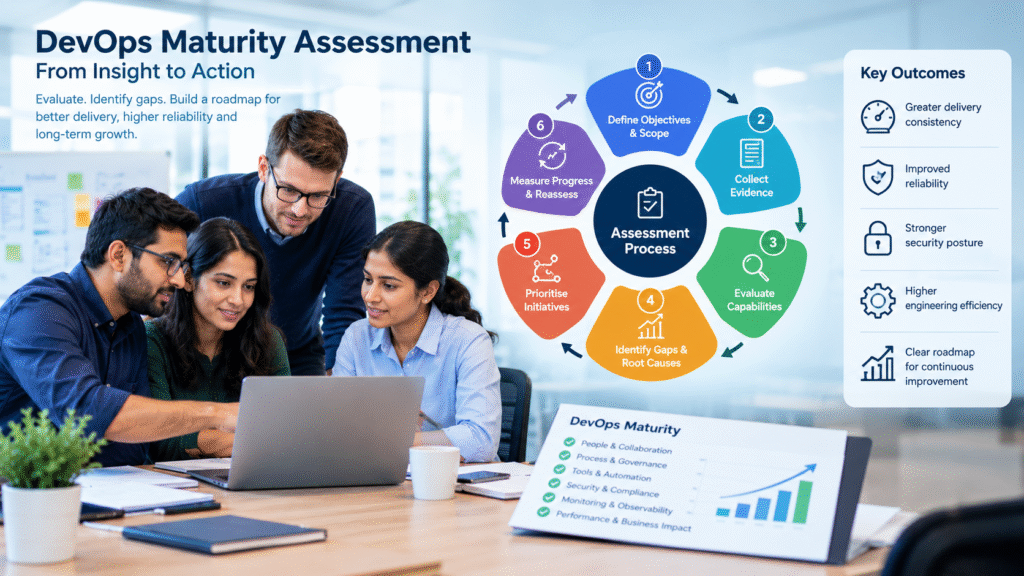
Contact Sandhata’s Enterprise Quality Strategy Specialists today to schedule your DevOps & SRE Maturity Compass Assessment and design a scalable software testing strategy tailored to your organization.



Leave a Comment
You must be logged in to post a comment.