
Table of Contents
End-to-End Test Automation for Enterprises | Quality Engineering | Sandhata
Modern enterprise software applications do not operate as simple, isolated programs. When a customer opens a mobile banking app to transfer money, submits an insurance claim online, or upgrades a telecommunications subscription, dozens of interconnected technology layers spring into action behind the scenes. A single customer click triggers frontend user interfaces, cloud API gateways, authentication services, middleware message queues, third-party payment networks, and core legacy mainframe databases.
While individual software teams may test their own isolated code modules thoroughly, severe business failures frequently occur in the gaps between connected systems. A minor API schema update in a cloud microservice or a subtle configuration change in a mainframe ledger can break an entire customer journey without triggering a single unit test failure.
Verifying that every connected component works together smoothly from the user’s first screen click to the final backend database record is the role of End-to-End Test Automation.
However, building reliable End-to-End Test Automation at enterprise scale is notoriously difficult. Traditional End-to-End test suites often become slow, brittle, and plagued by random failures caused by unstable staging environments, missing third-party services, and corrupted test data. When automated End-to-End tests take days to run and fail unpredictably, release pipelines stall and engineering confidence collapses.
This comprehensive guide explores how Sandhata Technologies designs and builds fast, resilient, and scalable End-to-End Test Automation architectures that protect critical business journeys across complex cloud and legacy mainframe ecosystems.
Section 1: Why Traditional End-to-End Testing Fails at Enterprise Scale
Understanding the structural reasons why conventional End-to-End testing breaks down is the first step toward engineering a dependable quality solution.
1.1 The Trap of the Inverted Testing Pyramid
Many organizations make the mistake of automating every single business scenario through slow user interface clicks. Instead of maintaining a healthy balance of fast unit and API tests underneath, they build thousands of heavy End-to-End browser tests.
Because user interface tests must render web pages, load assets, and wait for network calls, massive End-to-End suites take hours or days to complete. Worse, whenever developers adjust a button style or rearrange a page layout, hundreds of UI scripts break simultaneously, creating an unsustainable maintenance burden.
1.2 Cascading Failures from Unstable Downstream Dependencies
By definition, an End-to-End test touches multiple systems across the enterprise. If a single test journey connects to twelve different microservices, an external credit bureau sandbox, and a legacy mainframe partition, the failure of any one component causes the entire End-to-End test to fail.
In shared enterprise testing environments, downstream systems frequently go offline for maintenance, experience network timeouts, or run conflicting software versions. Quality engineers waste hours investigating failed End-to-End tests only to discover that the application code worked fine, while an external vendor server was temporarily unreachable.
1.3 Cross-System Test Data Collisions and Synchronization Errors
Executing a true End-to-End test requires consistent test data across every connected system. For example, a test customer profile must exist simultaneously in the cloud identity provider, the CRM database, the payment gateway, and the backend mainframe ledger.
When multiple teams run End-to-End tests concurrently in shared staging environments, one team’s test script frequently modifies or deletes test records needed by another team. Without synchronized, isolated test data, End-to-End suites produce rampant false-positive failures.
1.4 Slow Sequential Execution in Continuous Delivery Pipelines
Legacy automation tools execute End-to-End browser tests one after another in a single sequential queue. In modern continuous integration pipelines where developers merge code updates dozens of times per day, sequential End-to-End execution creates an unacceptable bottleneck, forcing teams to skip thorough validation or delay software releases.
Section 2: Core Engineering Pillars of Sandhata’s End-to-End Test Automation
Sandhata Technologies delivers specialized End-to-End Test Automation services designed to eliminate flakiness, decouple system dependencies, and accelerate execution across enterprise architectures.
2.1 Pillar 1: Strategic Journey Prioritization and the Balanced Pyramid
Sandhata helps organizations avoid bloated, slow test suites by applying disciplined Risk-Based Prioritization. Rather than automating every minor edge case through the user interface, Sandhata pushes detailed boundary and negative testing down to fast API and unit test layers.
End-to-End Test Automation is focused strategically on high-value, revenue-critical customer journeys—such as customer onboarding, payment settlement, policy underwriting, and order fulfillment. Keeping End-to-End suites lean and targeted ensures rapid execution while protecting core business workflows.
2.2 Pillar 2: Modern Framework Architecture with Playwright
To eliminate script brittleness and maximize speed, Sandhata constructs End-to-End automation frameworks using modern platforms like Playwright.
Playwright communicates directly with browser engines, includes built-in automatic element waiting to eliminate timing errors, and supports Chromium, Firefox, and WebKit out of the box. Crucially, Playwright allows quality engineers to combine frontend browser actions with direct backend API calls inside a single test script. Teams can use fast API requests to set up test preconditions in milliseconds, execute critical user clicks in the browser, and verify final database states via APIs, cutting execution times dramatically.
2.3 Pillar 3: Service Virtualization for Dependency-Free E2E Execution
To ensure End-to-End tests never stall waiting for unavailable external partners or legacy mainframes, Sandhata integrates Service Virtualization directly into the automation architecture.
Service Virtualization simulates the exact API responses, transactional payloads, and latency behaviors of external payment gateways, credit agencies, and core mainframe interfaces. Automated End-to-End suites run reliably twenty-four hours a day against virtualized endpoints without waiting for physical system availability or risking live production transactions.
2.4 Pillar 4: Cross-System Deterministic Test Data Management
Reliable End-to-End testing demands synchronized data across every architectural tier. Sandhata implements automated Test Data Management pipelines featuring deterministic data masking and synthetic data generation.
Deterministic masking ensures that a fictitious test customer profile shares identical account numbers, user IDs, and transaction histories across cloud databases, middleware queues, and legacy mainframe files simultaneously. Automated pipelines provision fresh, isolated synthetic datasets on demand before each End-to-End test run, eliminating data collisions while guaranteeing full compliance with GDPR and privacy regulations.
2.5 Pillar 5: Ephemeral Cloud Environments for Isolated Parallel Runs
To eliminate shared staging conflicts, Sandhata leverages Infrastructure as Code to spin up temporary, isolated cloud testing environments (ephemeral environments) on demand.
Whenever a release candidate is built, CI/CD pipelines spin up a clean, self-contained application stack, execute parallel Playwright End-to-End workers across multiple CPU cores, capture rich visual reports, and destroy the temporary environment immediately afterward. Parallel execution reduces multi-hour End-to-End suites down to minutes.
2.6 Pillar 6: Hyperautomation and Hybrid Mainframe Validation with ATOM2
Enterprise journeys frequently span both modern cloud web portals and decades-old IBM Z mainframes. Sandhata bridges this divide using specialized mainframe adapters and Sandhata’s proprietary ATOM2 hyperautomation platform.
ATOM2 enables a single End-to-End test workflow to submit an application on a modern cloud webpage, inspect XML/JSON messages passing through enterprise middleware, and verify final accounting ledger updates inside legacy COBOL and DB2 mainframe partitions automatically.
Section 3: Evaluating End-to-End Maturity with the Maturity Compass
Sandhata applies the proprietary DevOps & SRE Maturity Compass to evaluate an enterprise’s current End-to-End testing practices across 30 to 40 technical and operational dimensions.
Level 1: Manual End-to-End Verification. Critical customer journeys are tested manually by business analysts and QA teams across shared staging servers. Testing takes weeks per release, data synchronization is manual, and production defects occur frequently.
Level 2: Brittle Scripted UI Automation. Teams use legacy tools like older Selenium versions to automate basic browser clicks, but scripts suffer from high flakiness, slow sequential execution, and frequent failures whenever external systems go offline.
Level 3: Modular Continuous End-to-End Automation. Lean, high-impact customer journeys run automatically in CI/CD pipelines using modern frameworks like Playwright. Service Virtualization mocks unstable dependencies, deterministic test data prevents collisions, and Page Object Model patterns keep maintenance low.
Level 4: Autonomous Hybrid End-to-End Quality. Ephemeral environments spin up on demand for parallel End-to-End runs. ATOM2 hyperautomation orchestrates seamless validation across cloud microservices and legacy mainframes, while self-healing scripts and production observability telemetry continuously refine test coverage.
The Maturity Compass provides executive leadership with objective benchmark scores and a clear, phased roadmap to achieve reliable End-to-End automation.
Section 4: Enterprise Impact – Real-World End-to-End Automation Case Studies
Case Study 1: Global Retail Bank Automates End-to-End Mortgage and Payment Journeys
A tier-1 global retail bank operated complex digital lending and payment platforms connecting mobile apps, cloud microservices, external credit bureaus, and core mainframe ledgers. Manual End-to-End testing required three weeks per release, and fragile legacy scripts suffered from a thirty percent failure rate due to environment and data conflicts.
Sandhata deployed a team of Quality Engineering specialists to redesign the bank’s End-to-End automation architecture. Sandhata migrated critical customer journeys to a parallel Playwright framework, virtualized external credit bureau APIs using Service Virtualization, and implemented cross-system synthetic test data provisioning.
End-to-End regression execution time dropped by ninety-two percent, falling from three weeks down to under four hours. Test flakiness fell below one percent, defect escape rates to production dropped by eighty percent, and the bank accelerated from quarterly releases to bi-weekly digital updates.
Case Study 2: Major European Telecom Provider Streamlines Hybrid Order-to-Cash Testing
A multinational telecommunications provider struggled with recurring billing errors and slow launches when updating its digital order-to-cash journeys spanning web storefronts, CRM platforms, network provisioning engines, and legacy billing mainframes.
Sandhata implemented an integrated End-to-End Test Automation framework powered by Playwright, Service Virtualization, and Sandhata’s ATOM2 hyperautomation platform.
End-to-End test execution accelerated by eighty-five percent, billing defects in production dropped by ninety percent, and automated step-by-step audit reports saved thousands of compliance review hours annually.
Section 5: Essential Metrics for End-to-End Test Automation Success
Measuring the effectiveness of End-to-End Test Automation requires tracking clear operational metrics across coverage, speed, reliability, and business protection:
Critical Journey Coverage: The percentage of high-priority, revenue-generating end-user workflows validated by automated End-to-End suites, targeted at 100 percent coverage.
End-to-End Execution Duration: The total elapsed time required to execute the full End-to-End suite, reduced from days to under one hour via parallel worker execution and API-assisted setup.
Test Flakiness Rate: The percentage of End-to-End test failures caused by environment instability, network timeouts, or script timing issues rather than real bugs, kept below 1 percent.
Defect Escape Rate: The percentage of multi-system integration defects discovered in production relative to total defects caught during testing, targeted below 2 percent.
Script Maintenance Overhead: Tracking engineering hours spent updating End-to-End scripts after application releases, minimized through clean Page Object Model design and risk-based suite sizing.
Section 6: Frequently Asked Questions (FAQs)
FAQ 1: What is End-to-End Test Automation?
End-to-End Test Automation is a software testing method that automatically verifies a complete application workflow from start to finish. It mimics real user behavior across user interfaces, backend APIs, microservices, databases, and external third-party integrations to ensure every connected system works together seamlessly.
FAQ 2: How does End-to-End testing differ from unit testing and integration testing?
Unit testing checks small, isolated pieces of code in a vacuum. Integration testing checks the connection between two specific modules or APIs. End-to-End testing validates the entire business journey from the customer’s first screen click through every middleware layer and backend database update.
FAQ 3: Why are End-to-End automated tests often slow and flaky in traditional setups?
Traditional End-to-End tests often fail due to unstable staging environments, network delays, slow legacy automation tools, and shared test data collisions. When any single connected service goes offline, the entire End-to-End test fails.
FAQ 4: How does Sandhata eliminate flakiness in End-to-End Test Automation?
Sandhata eliminates flakiness by migrating legacy scripts to modern frameworks like Playwright with built-in auto-waiting, applying clean Page Object Model architectures, virtualizing unstable third-party services, and provisioning isolated synthetic test data.
FAQ 5: What role does Service Virtualization play in End-to-End Test Automation?
Service Virtualization simulates unavailable third-party APIs, payment networks, and legacy mainframes. This allows End-to-End automated test suites to run continuously anytime without waiting for physical external systems to be online or configured.
FAQ 6: Why is Playwright ideal for enterprise End-to-End Test Automation?
Playwright executes tests much faster than older tools, automatically waits for web elements to stabilize before interacting, runs hundreds of isolated browser contexts in parallel, and can combine frontend UI clicks with backend API calls in a single test flow.
FAQ 7: Can End-to-End Test Automation validate legacy mainframes alongside modern cloud applications?
Yes. Sandhata builds hybrid End-to-End automation frameworks that initiate a user action on a cloud web portal, trace middleware messages, and verify final transaction updates inside legacy IBM mainframe databases automatically.
FAQ 8: How should teams balance End-to-End tests within the Test Automation Pyramid?
Teams should maintain a broad foundation of fast unit and API tests while keeping End-to-End UI tests focused strictly on critical, high-value customer journeys. This prevents bloated test suites and keeps build pipelines fast.
FAQ 9: How does Sandhata manage test data for End-to-End testing while staying GDPR compliant?
Sandhata uses deterministic data masking and synthetic test data generation to populate all connected systems with synchronized, realistic test datasets that contain zero real customer identity details, ensuring full GDPR compliance.
FAQ 10: How do ephemeral environments improve End-to-End Test Automation?
Ephemeral environments spin up temporary, isolated cloud stacks on demand for specific feature tests and tear them down afterward. This prevents multiple teams from colliding over shared staging servers during End-to-End test runs.
FAQ 11: How does Sandhata’s ATOM2 platform accelerate End-to-End Test Automation?
Sandhata’s ATOM2 platform provides low-code and no-code hyperautomation capabilities that connect modern web frameworks with legacy enterprise systems, allowing teams to orchestrate complex multi-system End-to-End workflows visually.
FAQ 12: How does End-to-End Test Automation support regulatory compliance in banking and healthcare?
End-to-End test pipelines capture complete step-by-step logs, screenshots, video recordings, and transaction traces for every critical business journey, providing tamper-proof audit evidence for DORA, PRA rules, PCI-DSS, and HIPAA.
FAQ 13: What metrics measure the success of End-to-End Test Automation?
Key metrics include Critical Journey Coverage, End-to-End Execution Duration, Test Flakiness Rate (kept under 1 percent), Defect Escape Rate, and Script Maintenance Effort.
FAQ 14: How does Sandhata assess an organization’s End-to-End testing readiness?
Sandhata uses the DevOps & SRE Maturity Compass to audit testing practices across 30 to 40 technical dimensions, identifying dependency bottlenecks, environment gaps, and script flakiness before building a tailored roadmap.
FAQ 15: How long does it take to implement End-to-End Test Automation with Sandhata?
Initial diagnostic audits take 2 to 4 weeks. Designing a modular framework, virtualizing key dependencies, and automating core End-to-End customer journeys typically delivers measurable results within 8 to 12 weeks.
Strategic Recommendation and Next Steps
Relying on manual End-to-End verification, slow sequential legacy scripts, shared staging bottlenecks, and uncoordinated test data leaves enterprise organizations vulnerable to costly multi-system integration failures and slow product launches. To deliver seamless digital experiences at speed, technology leaders must engineer fast, reliable, and decoupled End-to-End validation.
End-to-End Test Automation protects your most critical customer workflows. By prioritizing high-value business journeys, building modular frameworks with Playwright, virtualizing external dependencies, synchronizing deterministic synthetic test data, and leveraging ephemeral cloud environments, organizations achieve rapid software delivery with complete confidence.
Sandhata Technologies brings over two decades of engineering excellence in enterprise quality automation, hybrid cloud-mainframe integration, and DevOps transformation across heavily regulated global industries.
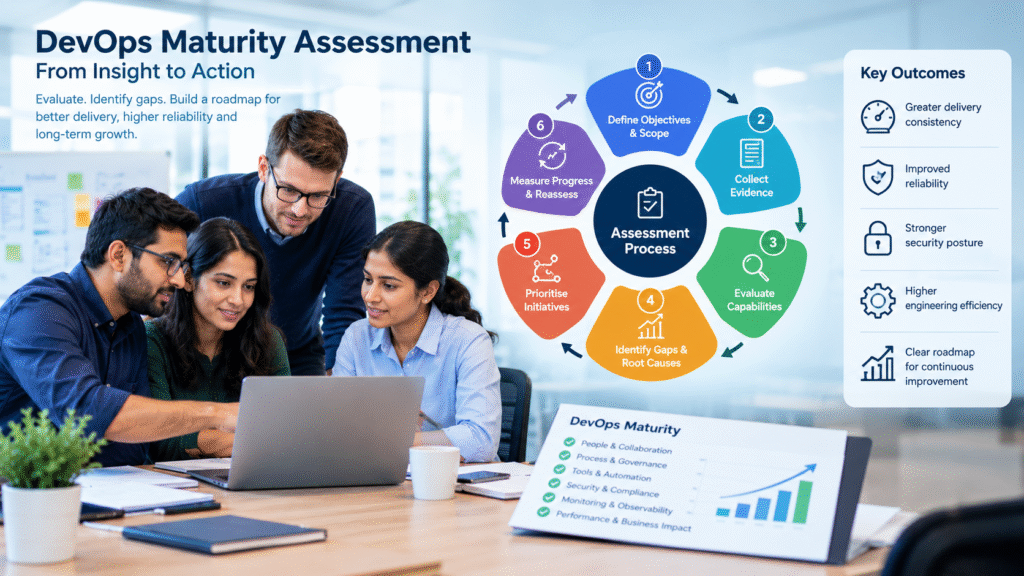
Contact Sandhata’s Quality Engineering Specialists today to schedule your DevOps & SRE Maturity Compass Assessment and build a scalable End-to-End Test Automation platform.



Leave a Comment
You must be logged in to post a comment.