
Table of Contents
Integration Test Automation Services | API & Hybrid QE | Sandhata
Modern enterprise software architectures no longer consist of single, self-contained applications. Instead, digital business operations run across sprawling, distributed ecosystems composed of cloud microservices, mobile API gateways, enterprise service buses, event streaming platforms like Apache Kafka, external vendor SaaS tools, and core legacy mainframes.
While breaking monolithic software into specialized services allows agile engineering teams to build and deploy features independently, it also creates a major operational vulnerability. In modern enterprise environments, software systems rarely fail because of isolated logic errors inside a single component. They fail at the boundaries where separate systems connect and exchange data.
A minor field rename in a customer profile API, an unexpected null value in a Kafka event message, or a character encoding mismatch between a cloud JSON service and a mainframe COBOL program can trigger cascading outages across the entire business.
Verifying that every connected interface, database query, message queue, and third-party gateway communicates accurately is the mission of integration testing. However, relying on manual API checks or waiting for massive, fragile shared staging environments slows software releases to a crawl.
Integration Test Automation Services solve this foundational challenge. By embedding automated contract testing, multi-protocol API validation, middleware message verification, and Service Virtualization directly into continuous integration pipelines, enterprise organizations detect connection defects early and release complex distributed systems with total confidence.
This comprehensive guide explores why integration failures plague modern enterprises, how structured integration automation operates across synchronous and asynchronous architectures, and how Sandhata Technologies helps global organizations achieve seamless system reliability.
Section 1: Why Integration Points Are the Highest Risk in Enterprise Software
Understanding how distributed software systems break down at connection boundaries is essential for designing a resilient quality engineering strategy.
1.1 Uncoordinated API Changes Across Agile Squads
In large organizations, dozens of agile development squads build and update interconnected microservices simultaneously. Squad A updates a payment calculation API to support new regional tax rules, unknowingly altering an optional JSON response field that Squad B’s mobile checkout service expects.
Because each squad runs its own isolated unit tests using local mocks, both teams see green build lights. The breaking defect remains completely hidden until both services are deployed together in a shared staging environment—or worse, in live production—causing immediate transaction failures.
1.2 Complex Asynchronous Event Flows and Middleware Transformations
Modern enterprise architectures rely heavily on asynchronous, event-driven communication over enterprise message brokers such as Apache Kafka, IBM MQ, RabbitMQ, and Enterprise Service Buses (ESBs).
A single customer action frequently triggers a chain reaction of asynchronous events routed across multiple middleware topics, transformed through XML/JSON mapping engines, and persisted across multiple databases. Manually tracing and verifying message delivery, ordering, error dead-letter queues, and data transformations across distributed middleware layers is nearly impossible at scale.
1.3 Hybrid Cloud-to-Mainframe Data Translation Friction
Established banks, insurers, and telecommunications operators connect modern cloud microservices to core IBM Z mainframes via z/OS Connect APIs, CICS web services, and IBM MQ bridges.
Translating modern UTF-8 JSON payloads into fixed-length COBOL copybooks and EBCDIC mainframe formats introduces subtle truncation errors, decimal precision mismatches, and timeout failures that standard unit tests cannot detect.
1.4 Shared Staging Environment Bottlenecks and Fragile UI Testing
Many organizations attempt to test system integrations exclusively through slow end-to-end browser scripts running against massive, shared staging environments. When twenty teams deploy unstable code into the same shared environment simultaneously, integration tests fail constantly due to unavailable downstream servers, corrupted test data, and conflicting service versions.
Section 2: Core Engineering Pillars of Sandhata’s Integration Test Automation Services
Sandhata Technologies brings over two decades of deep enterprise integration, middleware, and quality engineering expertise to help organizations build fast, reliable integration testing frameworks across six core pillars.
2.1 Pillar 1: Consumer-Driven API Contract Testing
To eliminate breaking API changes between agile squads without relying on slow shared staging environments, Sandhata implements Consumer-Driven Contract Testing.
In contract testing, every service that consumes an API defines a clear, automated contract specifying the exact requests it sends and the response fields it expects. Whenever an API provider team modifies its code, automated contract checks run in seconds inside the CI/CD pipeline, verifying immediately whether the update violates any consumer agreements. Teams catch breaking interface changes before code is even merged.
2.2 Pillar 2: Multi-Protocol API and Microservice Integration Automation
Sandhata constructs modular, code-driven integration test suites capable of validating complex multi-step workflows across synchronous and asynchronous protocols.
Using modern frameworks such as Playwright API testing, REST Assured, and specialized protocol adapters, automated tests validate RESTful JSON endpoints, SOAP XML web services, GraphQL queries, and high-speed gRPC streams—verifying HTTP status codes, schema structures, authentication tokens, error payloads, and database persistence rules automatically.
2.3 Pillar 3: Middleware, Kafka, and IBM MQ Event Validation
To secure event-driven architectures, Sandhata builds specialized integration test harnesses for enterprise messaging platforms.
Automated test runners publish realistic event payloads onto Apache Kafka topics, RabbitMQ exchanges, or IBM MQ queues, intercept downstream consumer messages, validate middleware routing and transformation rules, and verify error handling across dead-letter queues automatically.
2.4 Pillar 4: Service Virtualization for Dependency-Free Integration Runs
Integration testing should never stall because an external payment gateway, third-party credit bureau, or mainframe testing partition is offline. Sandhata integrates Service Virtualization directly into integration test suites.
Service Virtualization simulates unavailable downstream systems, returning realistic stateful responses and simulating network latency or server errors on demand. Integration pipelines execute continuously twenty-four hours a day without waiting for external partner sandboxes or consuming expensive mainframe MIPS.
2.5 Pillar 5: Hybrid Cloud-to-Mainframe Integration Verification
Sandhata specializes in bridging modern cloud platforms with legacy mainframe backbones. Our hybrid integration test suites validate data flows seamlessly across cloud API gateways, middleware integration buses, z/OS Connect interfaces, and backend mainframe DB2 or VSAM stores—verifying that data conversions, decimal rounding, and transaction commits remain one hundred percent accurate end-to-end.
2.6 Pillar 6: Deterministic Synthetic Test Data and CI/CD Pipeline Gates
Reliable integration testing requires synchronized test data across every connected database and service. Sandhata implements automated Test Data Management pipelines featuring deterministic data masking and synthetic data generation, ensuring matching test identifiers exist across cloud and legacy systems while maintaining strict GDPR and PCI-DSS compliance.
All integration suites are packaged in lightweight Docker containers and integrated directly into Jenkins, GitHub Actions, GitLab CI, and Azure DevOps pipelines as automated quality gates.
Section 3: Evaluating Integration Testing Maturity with the Maturity Compass
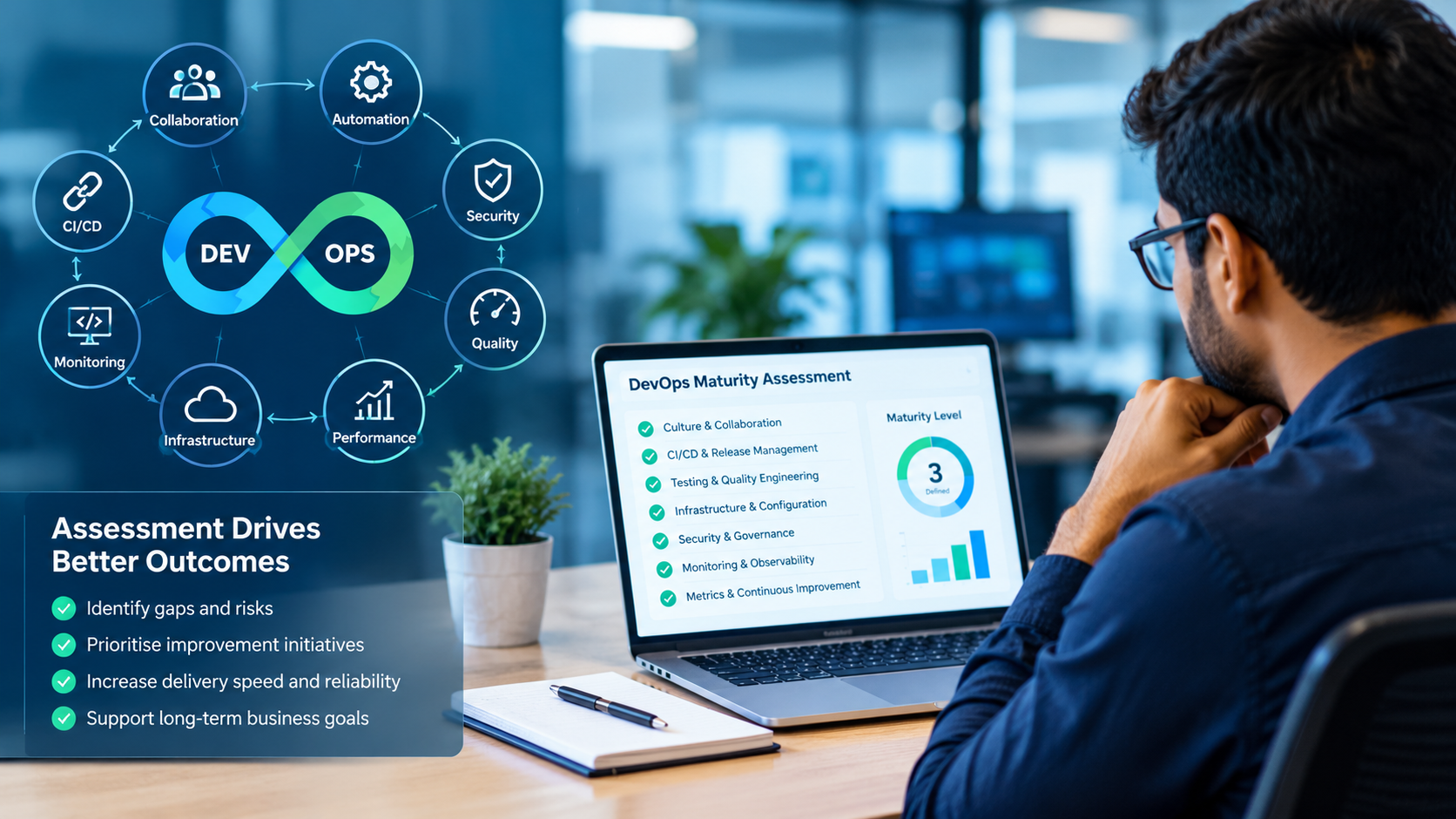
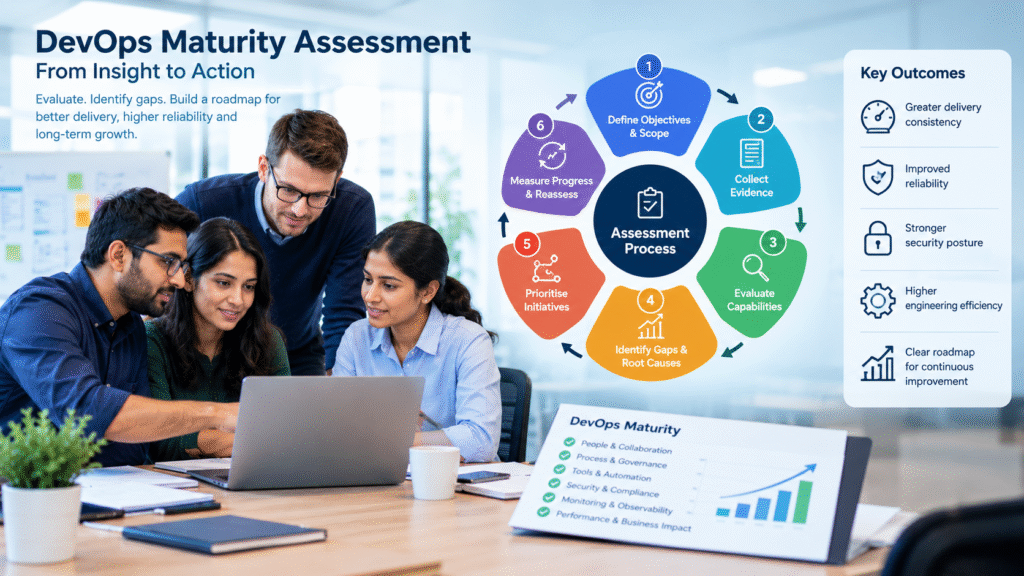
Sandhata applies the proprietary DevOps & SRE Maturity Compass to help technology leaders evaluate their integration quality practices across 30 to 40 technical and operational dimensions.
Level 1: Manual Ad-Hoc Interface Testing. Teams test APIs and middleware manually using standalone desktop tools right before major releases. Breaking API changes frequently reach staging or production, and shared environment conflicts delay launches by weeks.
Level 2: Basic Automated API Scripting. Individual teams write isolated API scripts, but asynchronous message queues, mainframe interfaces, and third-party dependencies remain untested or reliant on fragile shared staging servers.
Level 3: Automated Contract Testing and Service Virtualization. Consumer-driven contract tests run automatically on every pull request. Containerized integration suites validate REST, Kafka, MQ, and database interactions in CI/CD pipelines, while Service Virtualization eliminates external environment wait times.
Level 4: Autonomous Hybrid Integration Quality Engineering. AI-driven hyperautomation via Sandhata’s ATOM2 platform orchestrates continuous multi-protocol integration validation across cloud microservices and IBM Z mainframes. Ephemeral environments spin up on demand, synthetic test data provisions via APIs, and automated audit logs guarantee continuous compliance.
The Maturity Compass provides executive leadership with objective benchmark scores and a clear, phased roadmap for eliminating integration bottlenecks.
Section 4: Enterprise Impact – Real-World Integration Testing Case Studies
Case Study 1: Global Retail Bank Eliminates Microservice and Mainframe Integration Failures
A tier-1 global retail bank operated over two hundred cloud microservices integrated with enterprise IBM MQ middleware and core IBM Z mainframe ledgers. Uncoordinated API updates and manual middleware testing caused frequent staging outages, delaying digital banking releases by an average of three weeks.
Sandhata deployed a team of Integration Quality Engineering specialists to modernize the bank’s testing platform. Sandhata implemented Consumer-Driven Contract Testing across all microservice teams, built automated IBM MQ and API integration suites, and deployed Service Virtualization for core mainframe interfaces.
Integration-related defects escaping to staging and production dropped by eighty-six percent. Integration test execution time fell from days to under twenty minutes inside CI/CD pipelines, enabling the bank to move from monthly release cycles to weekly updates.
Case Study 2: Major Telecommunications Provider Secures Event-Driven Billing Pipelines
A multinational telecommunications provider relied on Apache Kafka event streams and complex middleware orchestrators to connect its digital customer portal with legacy billing engines. Manual verification of event transformations and billing records slowed down new product launches and risked revenue leakage.
Sandhata engineered an automated Kafka and API integration testing framework integrated with deterministic synthetic test data generation and Sandhata’s ATOM2 hyperautomation platform.
Automated integration coverage rose from twenty-five percent to over ninety percent, billing calculation errors dropped by ninety-two percent, and release lead times accelerated by seventy percent.
Section 5: Essential Metrics for Integration Test Automation Success
Measuring the strategic return on investment of Integration Test Automation Services requires tracking objective operational metrics across speed, interface reliability, and defect prevention:
Integration Defect Escape Rate: The percentage of API, schema, or messaging defects discovered in staging or production relative to total defects caught during early CI/CD contract and integration checks, targeted below 1 percent.
API Contract Compliance Rate: Measuring the percentage of microservice providers and consumers protected by automated contract tests inside pull request pipelines, targeted at 100 percent.
Integration Suite Execution Duration: The total elapsed time required to validate multi-service API, database, and middleware workflows, reduced from days to minutes via containerized parallel execution.
Environment Wait Time Reduction: Tracking engineering hours saved by eliminating delays caused by unavailable downstream services or mainframe partitions through Service Virtualization.
Automated Interface Coverage: Measuring the percentage of internal APIs, asynchronous message topics, and external partner integrations covered by automated regression tests.
Section 6: Frequently Asked Questions (FAQs)
FAQ 1: What are Integration Test Automation Services?
Integration Test Automation Services are specialized software engineering solutions that automatically verify how different software modules, microservices, APIs, databases, middleware queues, and third-party systems communicate and exchange data with one another, catching connection defects before production deployment.
FAQ 2: How does Integration Testing differ from Unit Testing and End-to-End Testing?
Unit testing checks individual functions in isolation using mocked dependencies. End-to-End testing checks an entire user journey from the front-end screen down to the database. Integration testing sits in the middle, verifying the exact communication interfaces, data schemas, and message routing between connected services and databases.
FAQ 3: Why do enterprise applications fail most frequently at integration points?
Individual development teams test their own code well, but problems arise when connected teams update API fields, change data formats, alter authentication rules, or introduce network latency without coordinating across system boundaries.
FAQ 4: What is Consumer-Driven Contract Testing and how does it improve integration quality?
Consumer-Driven Contract Testing verifies that an API provider respects the exact request and response expectations defined by the services consuming it. It catches breaking API changes in seconds inside CI/CD pipelines without needing slow, expensive full-stack staging environments.
FAQ 5: How does Service Virtualization support Integration Test Automation?
Service Virtualization simulates unavailable third-party APIs, payment clearinghouses, and legacy mainframes. This allows integration test suites to execute continuously anytime without waiting for physical external systems to be online or configured.
FAQ 6: Can Integration Test Automation validate asynchronous messaging systems like Kafka and IBM MQ?
Yes. Sandhata builds automated integration test frameworks that publish test messages onto Apache Kafka topics, RabbitMQ brokers, or IBM MQ queues, verify message transformations across middleware layers, and confirm accurate database persistence.
FAQ 7: How does Sandhata test integrations between modern cloud apps and legacy mainframes?
Sandhata constructs hybrid integration test suites that validate REST APIs, z/OS Connect gateways, IBM MQ bridges, and mainframe DB2/VSAM updates simultaneously, ensuring seamless data translation between modern JSON and legacy EBCDIC formats.
FAQ 8: How does Sandhata manage test data for integration testing while maintaining GDPR compliance?
Sandhata implements deterministic data masking and synthetic test data generation to ensure that matching, realistic test identifiers exist across all connected databases and APIs without exposing real personal customer information.
FAQ 9: Why is Integration Testing a critical part of the Test Automation Pyramid?
Integration tests form the vital middle tier of the Test Automation Pyramid. They run much faster and break far less often than full browser UI tests while catching critical multi-service communication bugs that isolated unit tests miss.
FAQ 10: How does Integration Test Automation integrate with CI/CD pipelines?
Sandhata configures CI/CD tools such as Jenkins, GitHub Actions, and GitLab CI to run automated API contract checks on every pull request and trigger containerized integration test suites before promoting builds to staging.
FAQ 11: How does Sandhata’s ATOM2 platform accelerate Integration Test Automation?
Sandhata’s ATOM2 hyperautomation platform provides low-code connectors for APIs, middleware buses, databases, and mainframes, allowing teams to design, run, and report complex multi-protocol integration tests rapidly.
FAQ 12: How does automated integration testing support regulatory compliance in banking and healthcare?
Automated integration pipelines verify encryption protocols, authorization tokens, and data integrity across system boundaries while generating immutable audit logs required by DORA, PRA rules, PCI-DSS, and HIPAA.
FAQ 13: What key metrics measure the success of Integration Test Automation Services?
Key metrics include Integration Defect Escape Rate, API Contract Compliance Rate, Integration Suite Execution Duration, Environment Wait Time Reduction, and Automated Interface Coverage.
FAQ 14: How does Sandhata evaluate an organization’s integration testing maturity?
Sandhata applies the proprietary DevOps & SRE Maturity Compass to audit interface dependencies, contract testing practices, middleware observability, and environment bottlenecks across 30 to 40 technical dimensions.
FAQ 15: How long does it take to implement Integration Test Automation Services with Sandhata?
Initial architectural discovery and Maturity Compass assessments take 2 to 4 weeks. Implementing automated contract tests, middleware validation frameworks, and Service Virtualization pilots delivers measurable operational gains within 6 to 10 weeks.
Strategic Recommendation and Next Steps
Allowing distributed microservices, event-driven middleware, and hybrid mainframe connections to go unverified until late manual staging cycles exposes enterprise organizations to recurring production outages, costly bug rework, and slow software releases. To achieve true continuous delivery across complex architectures, technology leaders must make integration testing fast, automated, and continuous.
Integration Test Automation Services secure the critical connections powering your digital business. By implementing Consumer-Driven Contract Testing, automating multi-protocol API and Kafka/MQ validation, virtualizing unavailable dependencies, and embedding containerized integration gates into CI/CD pipelines, organizations accelerate software delivery while guaranteeing system reliability.
Sandhata Technologies brings over two decades of proven engineering excellence in enterprise integration, middleware engineering, and quality automation across heavily regulated global industries.
Contact Sandhata’s Integration Quality Engineering Specialists today to schedule your DevOps & SRE Maturity Compass Assessment and eliminate integration failures across your delivery pipelines.



Leave a Comment
You must be logged in to post a comment.