
Table of Contents
AI-Powered Test Automation for Enterprises | Next-Gen QE | Sandhata
To remain competitive in today’s fast-moving digital economy, enterprise organizations must deliver new software features, mobile updates, and cloud services faster than ever before. Modern enterprise application stacks combine modern cloud microservices, web user interfaces, middleware messaging layers, external vendor payment APIs, and core legacy mainframes.
Verifying that continuous code updates do not break critical business processes represents a major technical challenge. Traditional manual testing cannot keep up with high-speed release schedules. Even standard automated testing frameworks struggle under enterprise scale. Conventional automated test scripts are rigid and fragile; whenever developers update a user interface, change an API field, or modify an application workflow, traditional test scripts fail.
Engineering teams spend countless hours fixing broken scripts and investigating false alarms instead of testing new features.
AI-Powered Test Automation for Enterprises resolves these systemic challenges. By integrating artificial intelligence, machine learning algorithms, computer vision, and generative models directly into software quality workflows, enterprise testing becomes self-healing, predictive, and continuously adaptive.
This comprehensive guide presents the technical strategies, artificial intelligence architectures, and implementation models that Sandhata Technologies delivers to help global enterprises modernize software testing into an automated, high-speed growth engine.
Section 1: The Modern Enterprise Quality Challenge and the Shift to AI
Enterprise technology environments operate under high operational complexity. Understanding why traditional testing approaches fail is essential for appreciating the value of artificial intelligence in quality engineering.
1.1 The Maintenance Trap of Traditional Automation
For years, enterprise organizations relied on scripted test automation tools to speed up software validation. While scripted automation works well for static applications, it struggles in modern continuous delivery pipelines.
Traditional test scripts depend on fixed locators to identify page elements. When developers update a button style, alter an HTML tag, or rearrange a webpage layout, traditional test scripts break instantly. This fragility causes high rates of false-positive test failures, commonly called test flakiness.
Quality assurance teams become trapped in an endless maintenance cycle. They spend more time fixing broken automation scripts and validating false alarms than building new automated test coverage. This high maintenance burden reduces team productivity, slows down release cadences, and forces companies to fall back on manual testing.
1.2 Long Test Execution Cycles and Pipeline Bottlenecks
As enterprise applications expand, automated test suites grow into tens of thousands of test cases. Running a full regression test suite across thousands of tests requires massive computing resources and takes hours or days to execute.
In continuous delivery environments where developers commit code multiple times a day, long test execution cycles create severe pipeline bottlenecks. Developers wait hours to find out if their code changes caused defects, slowing down feature delivery and delaying urgent security patches.
1.3 Test Data Management and Privacy Restrictions
Creating and managing realistic test data is one of the most difficult parts of enterprise software testing. Automated tests require specific, predictable data scenarios to run correctly.
However, copying live production customer databases into non-production testing environments violates strict international data privacy laws like GDPR and HIPAA. Manually crafting synthetic datasets takes substantial time and often fails to capture the true complexity of real-world production transactions.
Section 2: Core Engineering Pillars of AI-Powered Test Automation
Sandhata Technologies delivers specialized AI-Powered Test Automation Services designed to transform enterprise quality assurance into an intelligent, self-sustaining capability. Sandhata combines advanced machine learning algorithms, generative models, computer vision, and low-code hyperautomation into a cohesive quality engineering platform.
2.1 Pillar 1: Self-Healing Test Automation Scripts
The most immediate operational benefit of AI in test automation is self-healing script capabilities.
When an automated test script executes against an updated web page or application interface, traditional tools fail immediately if an element locator changes. In contrast, an AI-powered self-healing framework uses machine learning algorithms to evaluate multiple element attributes simultaneously, such as text labels, element position, parent containers, neighbor elements, and visual appearance.
If a primary element locator changes, the AI algorithm identifies the intended element using secondary visual and structural attributes. The AI dynamically updates the locator in real time, allows the test to complete successfully, and logs the suggested locator fix for engineers to review. Self-healing technology eliminates script flakiness, reduces false alarms by up to 90 percent, and dramatically lowers ongoing script maintenance effort.
2.2 Pillar 2: Generative AI Test Case and Script Generation
Generative AI transforms how software tests are created. Historically, quality engineers spent days reading user requirements, drafting manual test cases, and writing automation code line by line.
Sandhata integrates Generative AI models into enterprise development workflows. Generative AI tools analyze business requirements, user story documents, and source code repositories automatically. The AI generates comprehensive test scenarios covering happy paths, edge cases, boundary conditions, and negative test paths instantly.
Furthermore, Generative AI models convert these natural language test scenarios into production-ready automated test code in frameworks like Playwright, Selenium, or Cypress. This automated creation speeds up test suite development by up to 70 percent.
2.3 Pillar 3: Predictive Quality Analytics and Smart Impact Analysis
Running every test in a massive enterprise regression suite for minor code changes is inefficient. Sandhata implements AI-driven predictive quality analytics to optimize test execution within continuous integration pipelines.
AI impact analysis models evaluate incoming code commits, modified file paths, historical defect logs, and application dependency maps. The AI identifies the exact software modules affected by a specific code update and automatically selects only the relevant subset of tests required to validate the change.
Instead of running twenty thousand tests over ten hours, the pipeline runs fifty targeted tests in five minutes. This smart test selection reduces build execution times drastically while maintaining absolute defect detection confidence.
2.4 Pillar 4: Visual AI Regression Testing and Computer Vision
Traditional functional test scripts verify underlying data values but struggle to detect visual layout bugs, CSS styling glitches, overlapping text, or hidden page buttons.
Sandhata integrates Visual AI testing engines powered by computer vision. Visual AI captures screen snapshots during test runs and evaluates web page layouts like a human eye. Unlike basic pixel-matching tools that trigger false alarms over minor rendering shifts, Visual AI algorithms distinguish between intentional design changes and actual visual bugs across different screen resolutions, mobile devices, and browser engines.
2.5 Pillar 5: AI-Driven Synthetic Test Data Generation and Privacy Compliance
To solve the test data bottleneck while ensuring strict data privacy compliance, Sandhata implements AI-powered synthetic test data generation.
Generative AI models analyze the mathematical patterns, data relationships, and structural characteristics of production data environments without copying actual personal details. The AI generates realistic, synthetic test datasets that mirror real-world customer behaviors, edge cases, and transactional distributions. Automated pipelines inject fresh synthetic data into testing environments on demand, guaranteeing full data privacy compliance with regulations such as GDPR and HIPAA.
2.6 Pillar 6: AI-Enhanced Hyperautomation with Sandhata’s ATOM2 Platform
To maximize the reach of AI-powered testing across non-technical business teams, Sandhata leverages its proprietary hyperautomation platform, ATOM2.
ATOM2 provides low-code and no-code automation capabilities that connect AI testing algorithms with legacy mainframe platforms, enterprise resource planning systems, and cloud toolchains. Business analysts and subject matter experts can design complex end-to-end testing scenarios using simple visual workflows, while ATOM2 handles backend test execution, tool orchestration, and automated report generation.
Section 3: Evaluating AI Testing Readiness with the Maturity Compass
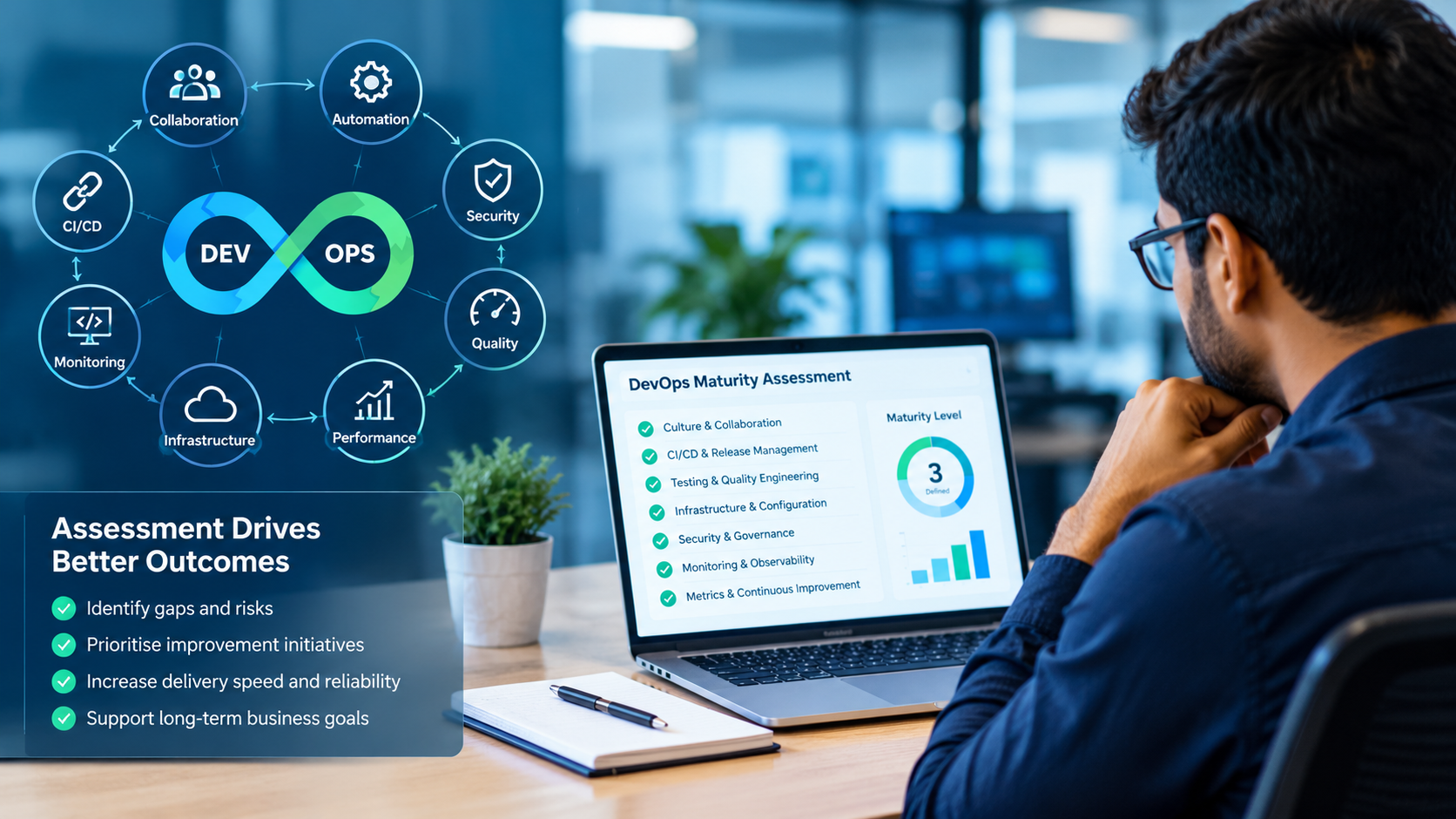
Sandhata applies the DevOps & SRE Maturity Compass to help enterprise leadership evaluate their current testing practices and map a structured transition toward AI-powered quality engineering.
Level 1: Manual Testing and High Flakiness. Software testing relies on manual execution and basic, fragile scripts. Test failures require manual investigation, test data creation is manual, release lead times take months, and maintenance costs are high.
Level 2: Basic Pipeline Automation. Continuous integration tools run automated unit and integration tests. However, test scripts fail frequently due to UI changes, regression execution takes hours, and test data management remains a bottleneck.
Level 3: Integrated AI Self-Healing and Smart Execution. Automated test suites incorporate self-healing algorithms to fix broken locators dynamically. AI smart test selection optimizes pipeline execution times, Visual AI checks UI layouts, and synthetic test data generation ensures privacy compliance.
Level 4: Autonomous Quality and Predictive Operations. Generative AI creates test suites automatically from requirements documents. Predictive analytics forecast software defect risks before deployment, while ATOM2 hyperautomation orchestrates zero-touch quality workflows across modern cloud and legacy mainframe applications.
The Maturity Compass provides senior executive leadership with absolute clarity regarding testing bottlenecks, technical debt, and strategic investment steps.
Section 4: Enterprise Impact – Real-World AI Testing Case Studies
Case Study 1: Tier-1 Investment Bank Accelerates Release Velocity with AI Testing
A global investment bank operated complex trading and wealth management platforms. Legacy automated regression suites took over 24 hours to execute, and fragile test scripts caused high rates of false-positive test failures, delaying software releases and inflating maintenance costs.
Sandhata deployed a team of AI quality engineering specialists to modernize the bank’s testing framework. Sandhata implemented AI self-healing script capabilities, deployed predictive AI impact analysis within CI/CD pipelines, and integrated synthetic test data generation.
Regression execution time dropped by 88 percent, falling from 24 hours down to under 3 hours. Self-healing algorithms reduced false-positive test failures by 92 percent, saving over 10,000 engineering hours annually and allowing bi-weekly software releases with complete confidence.
Case Study 2: Global Telecommunications Provider Reduces Testing Cycle Times
A multinational telecommunications provider struggled with long testing cycles when updating its online customer management and billing systems. Manual test creation and brittle scripts caused major launch delays for new mobile subscription plans.
Sandhata implemented an enterprise AI testing solution featuring Generative AI test case generation and ATOM2 low-code hyperautomation. Generative AI models generated test scripts directly from feature requirements, while Visual AI validated layout rendering across dozens of mobile device configurations.
Test suite creation lead time fell by 70 percent, while overall release testing execution accelerated by 80 percent, allowing the provider to launch new digital subscription packages months ahead of market competitors.
Section 5: Essential Metrics for AI-Powered Testing Success
Evaluating the return on investment of an AI-powered test automation transformation requires measuring key operational metrics across speed, script stability, coverage, and efficiency:
Test Flakiness Rate: The percentage of test failures caused by script locator issues or environment timing glitches rather than real software bugs, targeted below 1 percent with AI self-healing.
Regression Execution Duration: The total time required to run complete regression test suites, reduced from days to minutes using AI smart test selection.
Test Script Creation Speed: The time required to write automated test scripts for new features, accelerated by up to 70 percent using Generative AI model tools.
Defect Escape Rate: The percentage of software defects identified in production relative to total defects found during testing, targeted below 2 percent.
Maintenance Time Saved: The total engineering hours saved from manual script maintenance and false alarm investigations.
Data Privacy Compliance Rate: Verifying that 100 percent of non-production testing environments utilize synthetic or masked datasets.
Section 6: Frequently Asked Questions (FAQs)
FAQ 1: What is AI-Powered Test Automation for Enterprises?
AI-Powered Test Automation for Enterprises is an advanced software quality approach that uses artificial intelligence, machine learning algorithms, and generative models to automatically create, maintain, run, and analyze software tests across large-scale enterprise technology stacks.
FAQ 2: How does self-healing test automation work?
Self-healing test automation uses machine learning to detect when application user interfaces or element attributes change. Instead of failing the test script, the AI automatically identifies the modified element using alternative attributes, updates the test script, and allows the test to continue running successfully.
FAQ 3: How does Generative AI help in software testing?
Generative AI analyzes user stories, requirements documentation, and system code to automatically write comprehensive test cases, generate realistic synthetic test data, and create automated test scripts, significantly speeding up test creation.
FAQ 4: How does AI reduce test execution times in continuous integration pipelines?
AI algorithms analyze recent code changes and historical test results to identify the exact subset of tests impacted by a code update. Instead of running thousands of regression tests, the AI runs only the relevant tests, reducing build execution times dramatically.
FAQ 5: What is Visual AI Testing?
Visual AI Testing uses computer vision algorithms to evaluate application user interfaces like a human eye. It detects visual bugs, layout breaks, misaligned buttons, and color inconsistencies across different screen resolutions and browsers automatically.
FAQ 6: How does Sandhata’s ATOM2 platform support AI-powered testing?
Sandhata’s ATOM2 platform provides low-code and no-code hyperautomation tools that connect AI testing algorithms with existing enterprise delivery toolchains, simplifying test orchestration and allowing non-technical business users to participate in quality verification.
FAQ 7: Can AI-powered testing be applied to legacy mainframe systems?
Yes. Sandhata connects AI testing models with specialized mainframe adapters, allowing AI algorithms to analyze mainframe batch outputs, transaction logs, and COBOL application interfaces alongside modern cloud microservices.
FAQ 8: How does AI assist in synthetic test data generation and GDPR compliance?
AI models analyze real data structures and generate synthetic test datasets that mirror real-world production conditions without using any actual personal identity details, ensuring full compliance with GDPR and privacy regulations.
FAQ 9: What is Predictive Quality Analytics in software testing?
Predictive Quality Analytics uses machine learning to evaluate historical bug data, code commit complexity, and developer activity to predict which modules are most likely to contain defects, allowing teams to focus testing efforts where risk is highest.
FAQ 10: Does AI-powered test automation replace human software testers?
No. AI replaces repetitive manual tasks, script maintenance work, and routine test execution. This allows human quality engineers to focus on high-value strategic work, exploratory testing, complex business logic validation, and user experience improvements.
FAQ 11: How does AI-powered testing improve regulatory compliance in banking and healthcare?
AI-powered testing engines automatically verify that software meets security and regulatory requirements during build cycles, while generating detailed, tamper-proof audit trails for standards such as DORA, PRA rules, PCI-DSS, and HIPAA.
FAQ 12: What is the difference between traditional test automation and AI-powered test automation?
Traditional test automation relies on static, rigid scripts that fail whenever application code changes slightly. AI-powered test automation uses intelligent algorithms to adapt to changes automatically, generate new test cases dynamically, and predict system risk areas.
FAQ 13: How does Sandhata evaluate an enterprise’s readiness for AI test automation?
Sandhata uses the DevOps & SRE Maturity Compass to evaluate an organization’s testing tools, pipeline maturity, data structures, and automation skills across 30 to 40 technical dimensions before building a tailored AI testing transformation plan.
FAQ 14: How does AI help with API testing in microservice architectures?
AI tools analyze API documentation and network traffic logs to automatically map out backend dependencies, generate complex multi-endpoint API test scenarios, and detect unexpected API performance degradation automatically.
FAQ 15: How long does it take to implement AI-powered test automation with Sandhata?
Discovery audits and Maturity Compass assessments require 2 to 4 weeks. AI tool integration, self-healing setup, and initial pilot test suite creation deliver measurable operational improvements within 8 to 12 weeks.
Strategic Recommendation and Next Steps
Relying on brittle legacy test scripts, manual test case creation, long regression execution times, and unmasked test data exposes enterprise companies to high operational costs, slow release cadences, and significant risk of production software outages. To succeed in today’s digital market, enterprise leaders must upgrade their software testing strategy to an intelligent, automated, and self-healing capability.
AI-Powered Test Automation for Enterprises provides a practical path toward modern software quality. By implementing self-healing test automation, leveraging Generative AI for test creation, applying predictive quality analytics, generating synthetic test data, and deploying hyperautomation via ATOM2, enterprises can release software rapidly with complete confidence.
Sandhata Technologies brings over two decades of engineering excellence in enterprise quality automation, DevOps integration, and AI-driven software testing across heavily regulated industries.
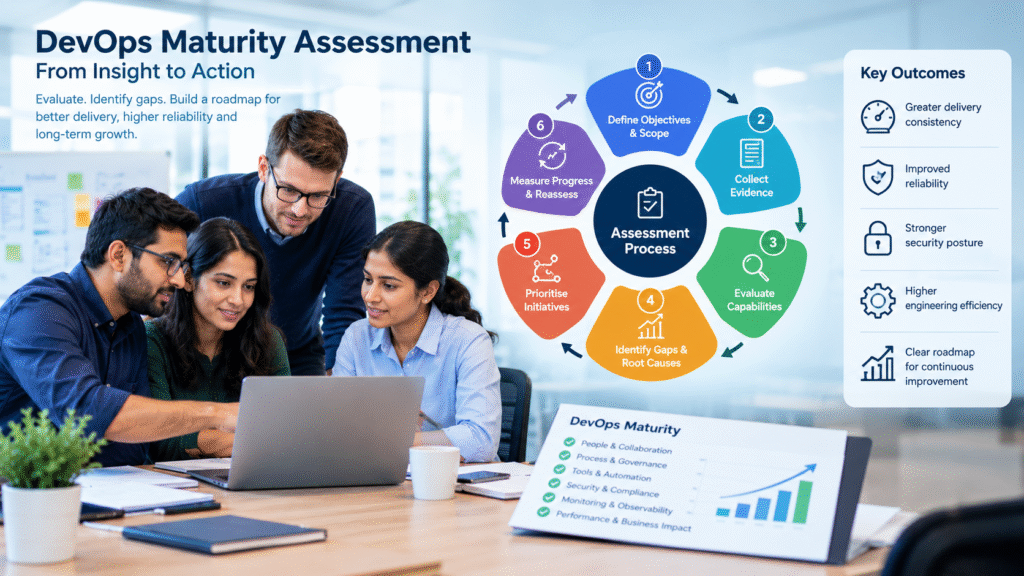
Contact Sandhata’s AI Quality Engineering Specialists today to schedule your DevOps & SRE Maturity Compass Assessment and build your next-generation intelligent test automation platform.



Leave a Comment
You must be logged in to post a comment.