
Table of Contents
DevOps Transformation Strategy for Enterprises
Enterprises increasingly depend on software to support customer services, internal operations, digital products and business growth. As technology environments expand, however, delivering software consistently becomes more complicated. Multiple development teams, legacy applications, cloud platforms, security requirements and manual release procedures can create bottlenecks across the software delivery lifecycle.
Introducing new tools alone rarely addresses these challenges. Organisations also need clear responsibilities, repeatable processes, effective testing, appropriate governance and reliable operational feedback.
A DevOps Transformation Strategy for Enterprises provides a structured approach to improving how software is developed, tested, deployed and maintained. It aligns people, processes, technology and business objectives so that delivery improvements can be implemented progressively and evaluated against meaningful outcomes.
For enterprise technology leaders, the goal is not simply to release software more frequently. It is to establish a sustainable delivery model that supports quality, security, operational stability and organisational adaptability.
This guide explains how enterprises can assess their current DevOps capabilities, build a transformation roadmap, prioritise automation, integrate security, measure progress and maintain improvements over time.
What Is a DevOps Transformation Strategy for Enterprises?
A DevOps transformation strategy is a planned approach to improving the relationship between software development and IT operations. It defines the practices, technical capabilities, responsibilities and governance required to deliver software more consistently.
For enterprises, the strategy must account for organisational scale and complexity. A company with dozens of applications, distributed teams and a mixture of legacy and cloud systems may need a different approach from a small software business.
An enterprise DevOps transformation strategy commonly addresses:
- Current delivery processes and maturity.
- Team collaboration and service ownership.
- Continuous integration and continuous delivery (CI/CD).
- Test automation and quality engineering.
- Infrastructure automation and environment consistency.
- Security integration and governance.
- Monitoring, observability and incident response.
- Legacy application delivery and modernisation.
- Performance measurement and continuous improvement.
The strategy should establish a clear starting point, define realistic priorities and explain how improvements will be implemented and evaluated.
It should also recognise that transformation is an ongoing organisational process, not a one-time technology deployment.
Why Enterprises Need a Structured DevOps Transformation Strategy
1. To reduce delivery bottlenecks
Enterprise software releases can involve several teams, environments and approval stages. Manual handovers, inconsistent procedures and unclear ownership can extend delivery timelines.
A transformation strategy examines the complete workflow, identifies avoidable delays and determines where standardisation or automation could help.
2. To improve consistency across teams
Different teams may use different tools, testing standards, deployment procedures and monitoring approaches. Some variation is necessary, but unnecessary differences can increase maintenance effort and operational risk.
Shared engineering standards, reusable pipeline components and clear platform responsibilities can improve consistency while allowing justified flexibility.
3. To integrate security throughout delivery
Security checks performed only near release may identify issues when remediation is more disruptive. A DevOps transformation can introduce appropriate security controls earlier in the lifecycle.
These may include dependency analysis, secrets detection, infrastructure configuration checks, vulnerability scanning and access controls.
4. To improve operational reliability
A successful deployment does not automatically mean that a service is healthy. Enterprises need monitoring, alerting, recovery procedures and clear incident ownership.
A coordinated strategy connects deployment practices with operational readiness so teams can detect and investigate problems effectively.
5. To support cloud and legacy environments
Many enterprises operate a combination of cloud-native services, on-premises infrastructure and established applications. Transformation should account for these differences rather than assume that every workload can adopt the same delivery model.
6. To establish measurable progress
Without agreed measures, organisations may struggle to determine whether investments in automation and new tooling are improving outcomes.
A structured strategy connects technical changes to measurable delivery, quality, reliability and operational objectives.
Core Pillars of an Effective Enterprise DevOps Strategy
1. People, culture and collaboration
DevOps depends on collaboration between developers, operations engineers, quality specialists, security teams and business stakeholders.
A transformation programme should clarify responsibilities across the software lifecycle. Teams need to understand who owns build pipelines, deployment processes, service monitoring, incident response and ongoing maintenance.
Useful practices include:
- Establishing clear service ownership.
- Encouraging shared responsibility for software quality.
- Reducing unnecessary handovers.
- Providing practical training and documentation.
- Creating feedback channels between engineering and operations.
- Supporting continuous learning from incidents and delivery problems.
Leadership support is important because organisational changes often affect established responsibilities, workflows and performance expectations.
2. CI/CD pipeline optimisation
Continuous integration helps teams integrate and validate code changes regularly. Continuous delivery uses repeatable processes to keep software ready for release.
An enterprise CI/CD strategy should define how code moves from development through testing and into production.
Potential improvements include automated builds, standardised pipeline templates, repeatable test execution, artefact management, environment configuration and controlled deployment processes.
The strategy should also consider pipeline security, failure diagnostics, approval requirements and rollback preparation.
Not every application requires an identical pipeline. A shared framework can provide common standards while allowing application-specific controls based on architecture and risk.
3. Test automation and quality engineering
Automated testing supports faster, repeatable feedback on software changes. However, automation is most valuable when it is supported by a clear testing strategy.
Enterprises should determine which tests belong at different stages of the pipeline. Unit and integration tests may provide early feedback, while broader regression, performance and end-to-end tests may be appropriate at later stages.
The strategy should address:
- Test coverage and gaps.
- Test data management.
- Unstable or flaky tests.
- Test-environment availability.
- Execution time and maintenance effort.
- Defect analysis and release criteria.
The objective is to improve confidence in software changes without creating an unnecessarily slow or difficult-to-maintain testing process.
4. Infrastructure as Code and environment management
Infrastructure as Code (IaC) allows infrastructure definitions to be maintained in version control and applied through repeatable workflows.
For enterprises, this can support more consistent environments, clearer change reviews and reduced configuration drift.
A transformation strategy may include infrastructure provisioning, configuration management, environment templates, secrets handling and infrastructure validation.
Organisations should also establish ownership of shared infrastructure components and define how changes are tested before reaching production.
5. DevSecOps and governance
DevSecOps integrates security practices into development and delivery rather than treating security as a separate final-stage activity.
Depending on application risk and organisational requirements, controls may include static analysis, dependency scanning, container security checks, secrets detection, access management and infrastructure policy validation.
The strategy should define how security findings are prioritised, who can approve exceptions and how remediation is tracked.
Governance must remain proportionate. Critical services and high-risk changes may require stronger controls, while lower-risk changes may be suitable for more automated pathways.
6. Monitoring, observability and Site Reliability Engineering
Monitoring and observability help teams understand application behaviour and investigate service problems.
A transformation programme may establish useful logs, metrics, traces, alerting rules, service dashboards and incident-management processes.
Site Reliability Engineering (SRE) can complement these capabilities through service-level indicators (SLIs), service-level objectives (SLOs), error budgets and structured incident reviews.
The right approach depends on service criticality, user expectations and the organisation’s ability to support operational responsibilities.
7. Architecture and legacy modernisation
Some enterprises cannot modernise every application at once. Established systems may have complex dependencies, limited automated tests or specialised release requirements.
The DevOps strategy should classify applications according to business importance, technical constraints, change frequency and operational risk.
Possible approaches include improving deployment automation around an existing system, introducing automated regression testing, modernising selected components or gradually moving suitable workloads to new platforms.
The objective is to make meaningful progress without creating unnecessary disruption to business-critical services.
How to Build a DevOps Transformation Roadmap
A roadmap converts strategic goals into a sequence of manageable activities.
Step 1: Define business outcomes
Begin by identifying the problems the transformation must solve.
Examples include lengthy release cycles, inconsistent environments, unreliable tests, high manual effort, limited release visibility or recurring operational incidents.
Define outcomes in terms that business and engineering stakeholders can understand. Avoid starting with a predetermined tool purchase before the underlying requirements are clear.
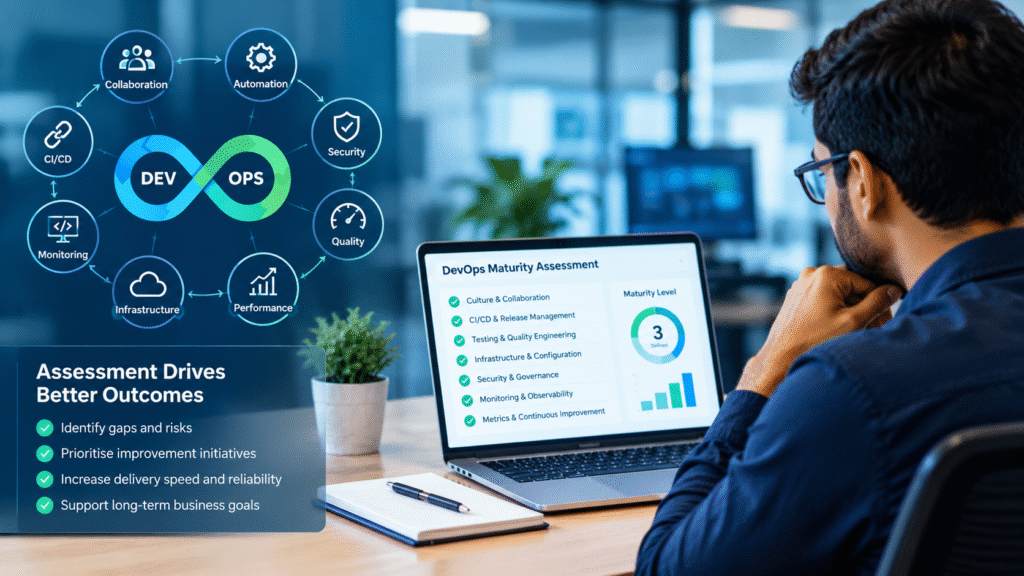
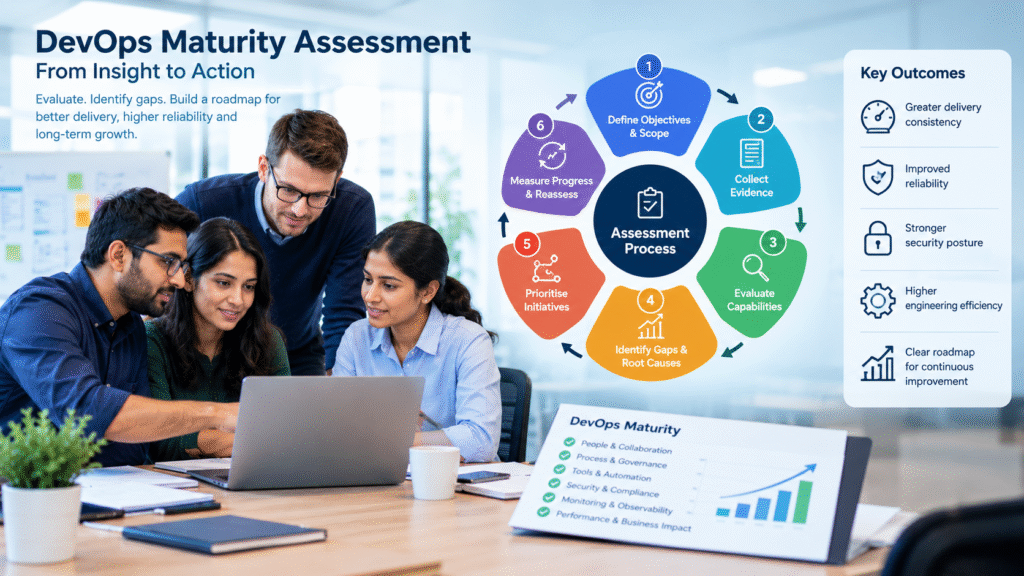
Step 2: Conduct a DevOps maturity assessment
Review current practices across people, processes, automation, quality, security, infrastructure and operations.
Evidence may come from workflow reviews, team interviews, pipeline analysis, incident records and existing performance measures.
The assessment should identify strengths as well as weaknesses and distinguish immediate risks from longer-term opportunities.
Step 3: Map the software delivery lifecycle
Document how changes move from development to production. Include testing, approvals, environment preparation, security reviews and post-deployment monitoring.
This end-to-end view helps reveal waiting periods, duplicated activities, unclear ownership and unnecessary complexity.
Step 4: Prioritise initiatives
Evaluate potential improvements according to business value, risk reduction, implementation effort, dependencies and maintenance requirements.
For example, improving a frequently failing deployment pipeline may be more valuable than introducing a new platform across every team.
Prioritisation should be transparent so stakeholders understand why particular activities come first.
Step 5: Select a pilot application or team
A focused pilot provides an opportunity to test the proposed approach under realistic conditions.
Choose a workload that is meaningful enough to generate useful evidence but manageable enough to limit the consequences of unexpected problems.
Agree on success criteria before implementation. These may include pipeline reliability, testing effectiveness, deployment consistency or reduced manual intervention.
Step 6: Implement and validate improvements
Introduce the selected changes, document decisions and gather evidence about their effectiveness.
Review technical performance as well as team experience. A pipeline that appears successful but is difficult to maintain may not be suitable for wider adoption.
Step 7: Scale through reusable practices
Once the pilot has been evaluated, refine the approach before expanding it.
Reusable templates, platform documentation, training and clear support arrangements can help additional teams adopt common practices.
Maintain flexibility for applications with different security, architectural or operational requirements.
Step 8: Establish continuous improvement
Review results regularly and update the roadmap as conditions change.
New applications, business priorities, regulatory requirements and technology dependencies may require adjustments. The strategy should therefore remain a working plan rather than a static document.
Measuring DevOps Transformation Success
A useful measurement framework should balance delivery speed, stability, quality and operational performance.
Deployment frequency
Measures how often an application or service is deployed. Interpret it in the context of application requirements and delivery practices rather than treating a higher frequency as universally better.
Lead time for changes
Measures the time taken for a code change to reach the relevant production environment, based on a consistent definition.
Change failure rate
Measures the proportion of deployments that result in a failure requiring intervention or remediation, according to the organisation’s defined criteria.
Failed deployment recovery time
Measures how long it takes to recover from a deployment-related failure.
These measures are commonly associated with DORA’s software delivery performance research. Enterprises should interpret them together and avoid turning individual metrics into simplistic targets.
Additional measures may include:
- Automated test reliability.
- Pipeline failure rates and causes.
- Vulnerability remediation time.
- Environment provisioning time.
- Service-level objective performance.
- Production incident impact.
- Time spent on repetitive operational work.
- Release approval waiting time.
Metrics should support learning and decision-making, not encourage teams to compromise quality to improve a dashboard.
Common DevOps Transformation Mistakes to Avoid
Treating transformation as a tool migration
Tools can enable better practices, but they cannot independently resolve unclear ownership, inefficient processes or poor collaboration.
Automating without simplifying
Automating an unnecessarily complicated workflow may preserve its underlying inefficiencies. Review the process before deciding what to automate.
Applying the same approach to every application
Different workloads have different dependencies, risks and release requirements. Establish shared principles while allowing appropriate application-specific implementation.
Ignoring security and governance
Security, auditability and access management should be considered during strategy development, not added as an afterthought.
Expanding too quickly
A pilot that has not been properly evaluated may reveal problems only after the approach is deployed across multiple teams. Validate and refine before scaling.
Failing to transfer knowledge
If only external consultants understand the new workflows, the organisation may struggle to maintain them after the engagement ends. Documentation, training and clear ownership are essential.
Measuring activity rather than outcomes
The number of tools deployed or pipelines created does not prove that delivery has improved. Evaluate actual workflow performance and operational results.
How Enterprise DevOps Consulting Can Support Transformation
Enterprise DevOps consulting can help organisations assess their current environment, define an improvement roadmap and implement suitable engineering practices.
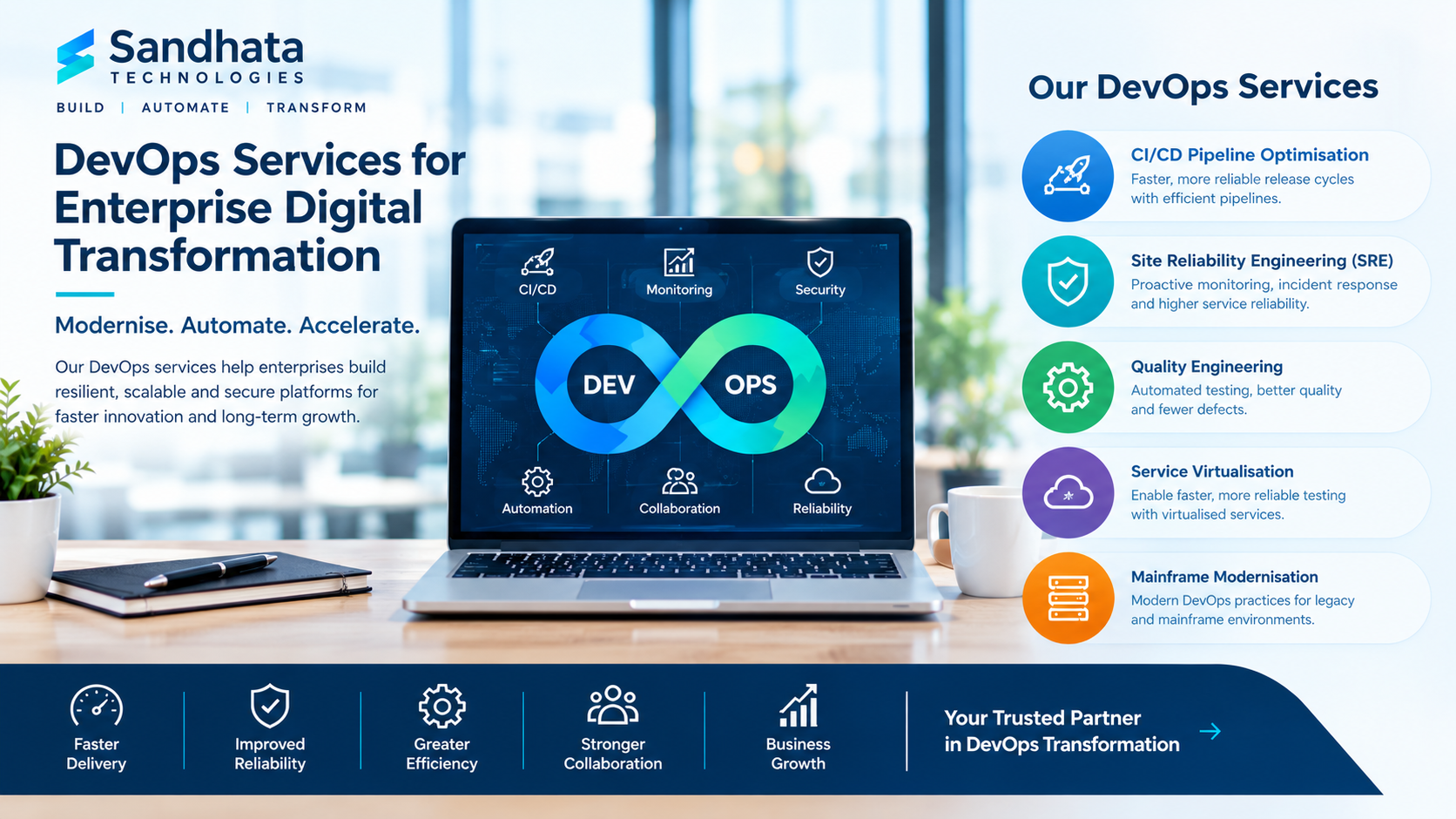
Depending on the organisation’s needs, consulting may cover maturity assessments, CI/CD pipeline optimisation, infrastructure automation, DevSecOps integration, quality engineering, service virtualisation, cloud engineering and SRE practices.
The value of an external partner depends on its ability to understand the existing architecture, work with internal teams and transfer practical knowledge.
For Sandhata Technologies, relevant enterprise engineering capabilities include DevOps and cloud-related services, Quality Engineering, Site Reliability Engineering, service virtualisation, system integration and legacy modernisation.
These capabilities can be considered together when an organisation’s transformation needs extend across application delivery, testing, system dependencies and operations.
Before selecting a consulting engagement, enterprises should establish the scope, expected deliverables, responsibilities, measurement approach and knowledge-transfer arrangements. Specific outcomes should be agreed based on the starting environment rather than assumed in advance.
Frequently Asked Questions
1. What is a DevOps transformation strategy for enterprises?
It is a structured plan for improving software development, testing, deployment and operations across an organisation. It aligns people, processes, technology and governance with defined business and engineering objectives.
2. Why is DevOps transformation important for large organisations?
Large organisations often manage multiple teams, complex applications, legacy systems and security requirements. A coordinated strategy helps identify bottlenecks and establish more consistent delivery practices.
3. What are the main pillars of enterprise DevOps transformation?
Common pillars include collaboration, CI/CD, test automation, infrastructure automation, security integration, monitoring, operational reliability and continuous improvement.
4. How should an enterprise begin its DevOps transformation?
Start by defining business objectives and assessing current delivery practices. Use the findings to prioritise improvements and select an appropriate pilot.
5. What is a DevOps maturity assessment?
It is a structured review of an organisation’s capabilities across areas such as automation, testing, security, collaboration and operations. It helps identify strengths, gaps and improvement priorities.
6. How long does enterprise DevOps transformation take?
The timeline depends on the organisation’s size, application complexity, technical constraints, team readiness and scope. A focused improvement initiative may take considerably less time than an organisation-wide transformation.
7. What is the role of CI/CD in DevOps transformation?
CI/CD provides repeatable processes for integrating, validating and preparing software for release. Effective pipelines can reduce manual work and make delivery more consistent.
8. Does DevOps transformation require cloud migration?
No. DevOps practices can support cloud, on-premises and hybrid environments. Cloud migration should be evaluated separately according to business and technical requirements.
9. How does DevSecOps fit into the transformation strategy?
DevSecOps incorporates appropriate security checks, access controls and vulnerability management into the software delivery lifecycle.
10. How does test automation improve DevOps?
Test automation provides repeatable feedback on software changes. A well-designed testing strategy can help teams identify defects and evaluate release readiness more consistently.
11. What is the difference between DevOps and SRE?
DevOps emphasises collaboration and integration between development and operations. SRE applies engineering practices to service reliability and operational objectives. The approaches can complement one another.
12. Which metrics should enterprises use to measure success?
Relevant measures include deployment frequency, lead time for changes, change failure rate, failed deployment recovery time, test reliability and service-level objective performance.
13. Can legacy applications adopt DevOps practices?
Yes. Legacy applications can often benefit from improved version control, automated testing, repeatable builds, deployment controls and monitoring. The approach should reflect their architecture and constraints.
14. What is infrastructure as Code?
Infrastructure as Code is the practice of defining and managing infrastructure through version-controlled configuration or code, supporting repeatable provisioning and change review.
15. How can enterprises reduce risk during transformation?
Use risk-based prioritisation, focused pilots, automated testing, suitable security controls, rollback planning and clear ownership. Validate improvements before expanding them.
16. What challenges commonly affect enterprise DevOps transformation?
Challenges include fragmented tools, unclear responsibilities, manual processes, legacy dependencies, unreliable tests, security constraints and resistance to organisational change.
17. Should all enterprise teams use the same DevOps tools?
Not necessarily. Shared standards can improve consistency, but tool selection should reflect existing architecture, integration needs, security requirements and operational support.
18. What should an organisation look for in a DevOps consulting partner?
Consider relevant enterprise experience, technical capability, security awareness, transparent measurement, collaboration, documentation and knowledge transfer.
19. How can enterprises maintain DevOps improvements over time?
Establish clear ownership, maintainable automation, documented standards, team training and regular performance reviews. Update the roadmap as business and technical requirements evolve.
20. How does DevOps transformation support digital transformation?
It can improve the processes used to build, release and operate digital services. This supports broader transformation initiatives by making software delivery more repeatable and responsive to changing requirements.
21. Is enterprise DevOps transformation only a technical project?
No. It involves organisational responsibilities, collaboration, governance and measurement as well as technical tools and processes. Sustainable change requires both engineering and organisational support.
22. What should a DevOps transformation roadmap include?
It should include business objectives, a maturity baseline, prioritised initiatives, dependencies, ownership, milestones, success measures and a plan for knowledge transfer and continuous improvement.
Conclusion
A successful DevOps transformation strategy for enterprises starts with a clear understanding of current delivery challenges and a realistic definition of the outcomes the organisation wants to achieve.
By combining collaboration, CI/CD, quality engineering, infrastructure automation, security and operational reliability, enterprises can build a more consistent approach to software delivery. Maturity assessments, focused pilots and evidence-based measurement help guide decisions, while documentation and knowledge transfer support long-term sustainability.
The objective is not to adopt every available tool or standardise every application indiscriminately. It is to establish a delivery model that fits the organisation’s architecture, business priorities and risk requirements.
For enterprises evaluating DevOps improvements, a practical next step is to assess the existing software delivery lifecycle, identify the most significant constraints and develop a roadmap that can be implemented and measured progressively.




Leave a Comment
You must be logged in to post a comment.